
Blog
The history and development of corundum synthesis methods


Introduction:
Corundum synthesis: synthetic crystals are certainly used in jewellery, where they must be identified as such to prevent counterfeiting, but their main applications are industrial. They are generally purer than their natural equivalents and lack the crystal defects that impair the physicochemical properties for which they are used. Electronics, computing, optics, technology and modernwatchmaking use them in large quantities.
Trying to imitate the finest natural stones is an ancient art: Pliny the Elder (23–79), in his Natural History, already mentioned making doublets — two stones or pieces of glass joined together — to resemble the gemstones that were most coveted. Western alchemy flourished in the 16th and 17th centuries: the philosopher's stone was supposed to enable base metals to be transmuted into gold. Within this ultimate, essentially philosophical quest lay the dormant spirit of crystal growth. This term refers to the science and techniques that enable minerals to be synthesised — in other words, made by humans.
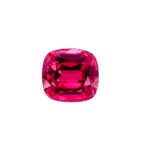
It was not until the 19th century that true crystal growth achieved its first successes. In 1847 and 1848, Jacques Joseph Ebelmen (1814–1852), a professor at the École des Mines and later administrator of the Sèvres porcelain manufactory, synthesised several millimetre-sized minerals, includingemerald, the corundum, spinel and peridot. In 1877, Edmond Frémy (1814–1894), a professor at the École Polytechnique and the Muséum d'Histoire naturelle, obtained centimetre-sized crystals of synthetic ruby .
From then on, crystal growth continued to advance, through both failures and brilliant successes in mastering crystal-growth processes. Today, there are many crystal-growth techniques, and they continue to improve.
Synthetic crystals are certainly used in jewellery, where they must be identified as such to prevent counterfeiting, but their main applications are industrial. They are generally purer than their natural equivalents and lack the crystal defects that impair the physicochemical properties for which they are used.
Electronics and computing are based on the properties of the ultra-pure crystals used in semiconductors. Optics and laser technology use them extensively. Modernwatchmaking uses synthetic rubies in mechanical watch movements and tiny resonators cut from high-quality synthetic quartz crystals in watches.
Crystal-growth techniques:
Most elements in the Earth's crust and mantle tend to crystallise as they solidify. Crystal growth essentially involves controlling the physicochemical conditions, principally temperature and pressure, during solidification to achieve the conditions in which the intended mineral is stable.
This control involves several techniques based on two approaches. The first takes a natural constituent in an initial physical state, called a phase — solid, liquid or gaseous — and modifies it through physicochemical operations until the desired solid is obtained. The second dissolves the starting material in an appropriate bath and changes the conditions to achieve supersaturation, thereby causing the desired mineral to crystallise.
In the first approach, physical phenomena predominate in approximating natural conditions: we will call this physical crystal growth. In the second, chemistry enables crystal growth through dissolution, whether in an anhydrous solution, a gaseous solution or hydrothermal growth.
1. Physical crystal growth
Physical crystal growth can begin from three states of matter. A distinction is therefore made between solid-state growth, crystallisation from a melt and vapour-phase growth.
a- Solid-state growth
This fairly old process uses two metallurgical techniques: annealing and sintering. Annealing involves heating a polycrystalline material above a critical temperature known as the recrystallisation temperature, without reaching its melting point. Under these conditions, the material recovers: recrystallisation takes place through the nucleation and growth of new crystals that gradually replace the old polycrystalline structure.
If annealing takes place very slowly, some crystals develop at the expense of others and can reach appreciable sizes. Applying pressure — annealing under stress — generally lowers the critical temperature and therefore accelerates growth. Sintering also involves heating without complete melting, but starts with a powdered material. Increasing the temperature and applying stress allow grains to agglomerate and crystals to grow through atomic diffusion.
b- Crystallisation from a melt
Liquid-phase growth, or growth from a molten bath, produces the best synthetic crystals but cannot be applied to certain materials, particularly those with a different crystal structure at high temperature from that at room temperature. Several synthesis methods are known, but the general principle is crystallisation from a micrometre-sized seed or crystallite that initiates the growth of the artificial crystal.
c- Method:
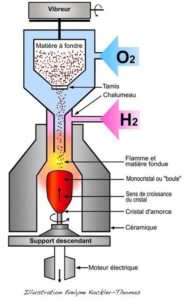
-The Verneuil process : The invention was developed as early as 1891 but officially presented in 1902 by the French chemist Auguste Victor Louis Verneuil (1856–1913). It uses an oxyhydrogen-flame furnace capable of generating very high temperatures, exceeding 2500°C. Synthesis is achieved by melting alumina: the powder is carried by the torch's oxygen stream and melts at a temperature above 2000 0C.
The resulting droplets fall onto a seed and crystallise, forming a bottle-shaped stem whose growth stops when its upper surface reaches too high a temperature near the flame. The growing crystal is surrounded by a refractory muffle to prevent rapid cooling that could break it. By the early 1910s, Verneuil was producing more than 3,000 kilograms of synthetic corundum — ruby and sapphire — annually.
Today, industrial processes derived from this method produce single-crystal ‘boules’ one metre long and ten centimetres in diameter. Around 200 tonnes of synthetic corundum are manufactured each year, notably in the French and Swiss Alps. Diagnostic inclusions: curved growth zones; clouds of gas bubbles sometimes following the growth curves; elongated gas bubbles in corundum; multiple veils following high-temperature annealing in corundum; exsolved rutile needles in Linde star corundum; and Plato lines in corundum.
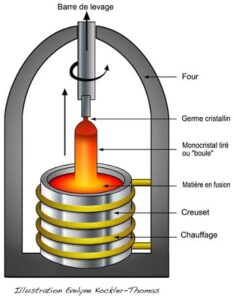
Vertical pulling growth, developed in 1916 and officially published in 1918 by the Polish chemist Jan Czochralski (1885–1953), is based on placing a seed in contact with molten material in a platinum or iridium crucible, under a reducing atmosphere. Depending on the desired result, the seed is pulled vertically at 2 to 25 mm per hour and rotated at no more than 30 revolutions per minute, drawing up material that crystallises as it cools.
The advantage of this process is that it produces very pure, large single crystals, highly prized by advanced industries such as aerospace and optics. For example, completely pure, colourless corundum can exceed 30 cm in diameter and 60 kg in weight, which would be impossible to produce using the Verneuil process.
During manufacture, metal oxides or rare-earth elements are commonly added to obtain very specific physical or optical characteristics.
Distinctive inclusions: gas bubbles, clouds of fine particles, stress zones, curved growth striae, cavities, hollow tubes, fine needles, white spicules, thread-like inclusions, negative crystals, iridium as tabular and sometimes hexagonal inclusions, and platinum as acicular or tabular and sometimes hexagonal inclusions..
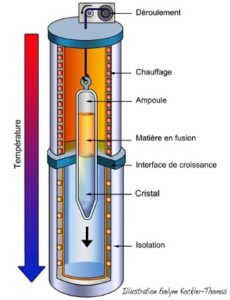
The vertical growth, Bridgman–Stockbarger process :
uses a cylindrical refractory crucible filled with the material to be crystallised. A furnace assembly surrounds the crucible and can move vertically, causing the material to melt and then crystallise slowly from bottom to top. This bulk crystallisation derives from the technique developed by Czochralski in 1918: a seed is immersed near the surface of liquid heated just above its melting point, locally cooling the bath. As crystals grow around the seed, the ingot is pulled upwards; this is also known as the ‘pulling’ method.
During formation, the crystalline ingot is continuously rotated to ensure perfectly homogeneous growth and isotropic optical qualities. Metal-oxide or rare-earth additives may produce different colours and, above all, alter the crystal's physical and optical characteristics. This manufacturing method is particularly suited to materials with fairly low melting points.
This property, and therefore the crystals obtained by this method, are used particularly to produce coherent light , primarily for laser technology. This led to the manufacture of YAG — yttrium aluminium garnet, an yttrium aluminate with the garnet crystal structure — Linobat — lithium niobate — and other materials for solid-state lasers .
Diagnostic inclusions: gas bubbles, clouds of fine particles and stress zones.
Vapour-phase growth: the Piper–Polich process:
Vapour-phase growth methods are based on sublimation: the direct transition of a substance, under particular temperature and pressure conditions, from solid to gas without passing through the liquid state.
Generally, vapour-phase growth results from combining two gases, one containing the material to be crystallised. For example, silicon (Si) can be grown by reducing gaseous silicon chloride (SiHCl3) with hydrogen (H2): SiHCl3 + H2 → Si + 3HCl. Thin-film deposition by vapour-phase epitaxy — VPE — or chemical vapour deposition, CVD, is widely used for silicon. Two conditions must be met for an epitaxial layer to be deposited.
First, atoms must find a place where they can lose their excess energy; these places are called nucleation sites. Second, the atoms must find a site in the lattice that can accommodate them. A crystal forms from a gaseous parent phase through a condensation reaction, at or away from equilibrium. The reaction occurs in a reactor equipped with a gas supply and recycling system.
For semiconductors of the III-Vtype, this technique falls into three main categories distinguished by the nature of the gaseous sources used. HVPE — Hydride Vapour Phase Epitaxy — uses hydride molecules; ClVPE — Chloride Vapour Phase Epitaxy — uses chlorides; and MOVPE — Metalorganic Vapour Phase Epitaxy — uses organometallic compounds. Each technique has a particular VPE reactor geometry involving different growth temperatures and deposition rates.
The Piper–Polich process involves placing a quantity of material at one end of a tube and sealing it. The tube is then slowly and partially inserted into a furnace and heated to a high temperature. When the material reaches its sublimation temperature, the gas solidifies at the cooler end of the tube, forming the desired crystals.
This type of technique requires pressures very close to ultra-high vacuum, achievable with modern techniques in large crystallisation chambers. Vapour-phase growth, alongside complex techniques such as electron bombardment, abrasion and atomic doping, has become an important industrial technique with the rise of microelectronics.
It is thus possible to restore an almost perfect crystalline surface on a single-crystal sample, grow rare and costly semiconductors on inexpensive surfaces such as silicon, and produce multilayer structures made of different crystal strata. However, the process remains expensive and slow.
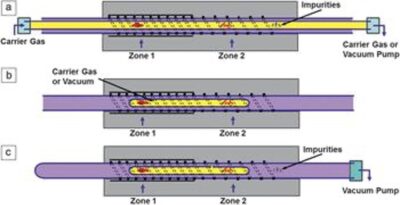
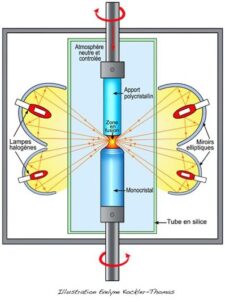
-Vertical floating-zone growth:
Discovered in 1928 by the Russian physicist Pyotr Leonidovich Kapitsa (Kapitza) (1894–1984) and subsequently improved in 1952 by the American scientist William Gardner Pfann (1917–1982); in 1953 by the American scientist Paul H. Keck and the Swiss scientist Marcel J. E. Golay (1902–1989); in 1961 by the German scientist Reimer Emeis; and in 1964 by the Russian-Armenian physicist Khachatur Saakovich Bagdasarov.
The principle was first used to purify material within the molten zone, then applied to the production of complete single crystals. In a horizontal position, a polycrystalline solid is heated to its melting point and then slowly solidifies into a single crystal at 2 to 15 millimetres per hour, depending on the material. Heating may use halogen lamps, resistance, induction, lasers, electron beams or plasma. The main advantage is the absence of a crucible, preventing impurities from being transferred into the crystal.
Distinctive inclusions: curved colour or growth zones, layers of fine particles and irregular cloudy formations in Seiko synthetic sapphire.
2. Chemical crystal growth:
Chemical crystal growth rests on a simple principle: supersaturation. Its natural equivalent occurs in salt marshes, where evaporating seawater becomes supersaturated with sodium chloride (NaCl), which then crystallises. The same applies to many other minerals, such as gypsum,anhydrite, halite, carnallite, sylvinite and others. These minerals are aptly grouped under the term ‘evaporites’. Specialists in chemical crystal growth seek to reproduce this process artificially using various methods applicable to many minerals.
a- Growth from solution:
Three types of process have been developed. In the first, supersaturation is achieved by reducing temperature. For example, potassium alum [K2SO4Al2(SO4)3, 24H2O] dissolves in pure water at a maximum of 240 grams per kilogram of solution at a temperature of 40 0C. Lowering this temperature makes the solution supersaturated at a rate of 9 grams per degree, so small crystals appear and cloud the solution. The faster the temperature drops, the larger the crystals; above a certain cooling rate, a single crystal appears.
The second type induces supersaturation by evaporating water from the solution, therefore requiring an increase in temperature.
The third type operates at a constant temperature. The Walker and Kohman method, developed in 1948, continually renews a solution that becomes less saturated as crystals grow. One vessel contains the solution in which the crystals form; this is gradually transferred to a second vessel holding a reserve of the material to be crystallised, the parent material.
The solution takes up this material and continues through a filter into a third vessel, where a higher temperature prevents premature crystallisation. It is then returned to the first vessel, whose lower temperature again causes supersaturation and the formation of new crystals, and the cycle continues.
Distinctive inclusions: flux residues, ‘fingerprints’ or healed fissures, distorted, contracted or elongated bubbles, two-phase and rarely three-phase inclusions, stress zones, platinum in acicular or tabular and sometimes hexagonal inclusions, parallel growth and/or colour zones in corundum, wispy comet-tail veils in Ramaura or Kashan synthetic ruby, stress zones and black grains.
b- Hydrothermal dissolution:
Discovered in 1847 by the French chemist Jacques Joseph Ebelmen (1814–1852) in the manufacture of tiny crystals, including spinel, Chrysoberyl, corundum and beryl, using a boric-acid- or borax-based flux. The technique was subsequently improved in 1888 by the French chemist Paul Gabriel Hautefeuille (1836–1902) and the engineer Adolphe Jean Edme Perrey to reproduce millimetre-sized emerald crystals using a lithium-molybdate flux, and in 1911 by the German company IG-Farbenindustrie AG.
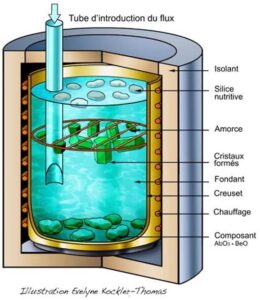
The process for producing opaque to translucent emerald crystals 20 mm long in 12 months is shown in the diagram on the left, using a lithium-molybdate and vanadate flux. From the late 1950s until around 1985, it was regularly improved to produce increasingly large beryl or corundum crystals of fine, facetable gem quality. The most representative commercial productions were those of the American Carroll C. Chatham in 1959, the French Pierre Gilson in 1963 and the Japanese Kyocera (Inamori) laboratory in 1978.
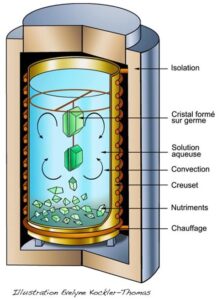
The top of the autoclave contains seeds and the bottom contains the starting, or parent, material. The components of the desired synthetic gem, an optional seed, nutrient silica, a colouring agent and an anhydrous — water-free — flux are placed in a platinum crucible. Everything is heated at ambient pressure to the temperature of dissolution and recrystallisation into single crystals. Slow cooling causes crystals to form and grow upwards towards the platinum grid.
Various modifications and other fluxes may be used, including lead fluoride; bismuth, lead or vanadium oxide; sodium borate or carbonate; and others. Production costs are relatively high because the complete process takes a long time — up to 12 months for the largest crystals. Different synthetics often bear the name of the scientist or company responsible for their manufacture, such as Ramaura or Knischka synthetic ruby.
The lower section is hotter than the upper section, causing hydrothermal fluid to move towards the seeds, where it cools and becomes supersaturated, allowing crystals to grow around them. As in any thermal system heated from below, a thermal gradient develops, causing vertical convection and continual enrichment of the hydrothermal fluid. Nucleation — the spontaneous appearance of crystals — can also occur in the autoclave. This resembles natural crystallisation in geodesunder the action of the Earth's hydrothermal fluids.
Diagnostic inclusions: sawtooth or chevron growth markings, straight colour zones, nail-shaped cavities with ‘breadcrumb’ heads, white, beige, brown or almost black ‘breadcrumb’ inclusions, phenakite as crystals or ‘breadcrumbs’, irregular hollow tubes, negative crystals, flattened or contracted fluid inclusions, ‘fingerprints’ or healed fissures, multiple veils, platinum wire, and metallic gold (Biron) or platinum inclusions.
Conclusion:
Synthesising corundum, aluminium oxide (Al2O3), is generally of little interest because it is abundant in nature. Only its coloured varieties warrant attention in crystal growth, since they belong to the four precious gemstones.
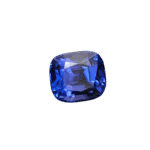
The first synthetic corundum was produced by Ebelmen in 1847, but it took another 30 years for Frémy to obtain the first synthetic rubies of usable size, chiefly for watchmaking. These were crystallised from a melt, initially using a simple torch and then, in 1902, the Verneuil process. The first synthetic sapphires were produced in 1907 with cobalt colouring, and in 1911 with iron-titanium colouring, all using the Verneuil process. Many anhydrous-solution growth processes were subsequently developed.
The high-quality rubies and sapphires used today are manufactured by the Czochralski or pulling method. Techniques have ultimately improved, increasing quality, reducing costs and raising production quantities. Although a scourge for the gemmological world, synthesis remains very important to the development of modern industry and therefore humanity.