Blog
The history and development of emerald synthesis methods


Introduction:
It is one of the four precious gemstones, alongside diamond, the ruby and sapphire, the latter two being varieties gemstones of corundum. Because of its value, emerald has many imitations made from a range of materials, starting with glass. These are generally doublets with a crown cut from a pale mineral — rock crystal, colourless beryl or a lower-quality pale emerald — and a glass pavilion. Other doublets consist of two slices of rock crystal joined with green cement; the lower quartz slice may contain fissures to imitate emerald inclusions. There are also doublets made of pale aquamarine , green cement and fissured tourmaline , which Colombian dealers offer tourists as ‘semi-precious emeralds’… All these doublet types can sometimes be difficult to recognise, particularly when already mounted and set. Nevertheless, anyone with a little knowledge can identify them fairly readily, unlike synthetics, which are now very common on the gemstone market. Produced by synthetic crystallisation in an aqueous environment, they result from experiments carried out over many years, namely flux and hydrothermal synthesis. Although all can be identified, at least as far as we know, an untrained person cannot distinguish a synthetic emerald from a natural one. Emerald is certainly one of the market's most imitated and treated stones, and probably among the oldest known to humanity.
A brief gemmological overview
Emerald is an aluminium and beryllium cyclosilicate with the formula Al2Be3(Si6O18). It crystallises in the hexagonal system, has a hardness of approximately 7.5 and a specific gravity of 2.67 to 2.78. Ranging from transparent to opaque, it displays a vitreous lustre and discontinuous, conchoidal fractures. Whether natural or not, it can be identified spectrometrically because it produces the chromium (Cr) spectrum: broad, diffuse absorption in the deep green-yellow, broad, moderately intense absorption at the beginning of the red wavelengths, and an intense, fine line in the deep red. Chromium is responsible for emerald's reddish to pinkish fluorescence under UV and its response through the Chelsea filter. As in other beryls, emerald's basic structural unit is a ring of six tetrahedra of silica (SiO44—), each with two free corners, corresponding to the formula (Si6O18)12—. These rings stack along the crystal's sixfold symmetry C axis; aluminium ions (Al3+) and beryllium ions (Be2+) lie between the silica rings and hold the structure together. Various elements occupy the spaces between or inside the rings (H2O, CO2, Na+, Li+, etc.). Aluminium is partly replaced by chromium (Cr3+) and vanadium (V3+), the elements responsible for emerald's green colour, and, less commonly, by magnesium (Mg2+) and ferric iron (Fe3+). Sometimes lithium (Li+) replaces beryllium, while aluminium can substitute for silicon (Si) in the rings. Emerald may display the optical phenomenon of chatoyancy or develop a trapiche pattern following its hexagonal symmetry. Its toughness is poor, hence the many inclusions present in numerous specimens. It reacts poorly to heat and ultrasound. Its diagnostic inclusions include:
-Three-phase inclusions
-Two-phase inclusions
-Needle inclusions
-Amphibole inclusions
-Pyrite inclusions
-Calcite inclusions
-Mica inclusions
-Mica inclusions
-Colour zoning
-Feather inclusions
-Crystal formation
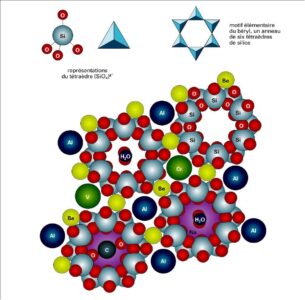
Its hardness; elongated hexagonal prismatic crystal habit; frequent inclusions; incomparable green colour; specific gravity; lustre; refractive index of 1.56 to 1.58 with birefringence of 0.003 to 0.005; negative uniaxial optical character; and responses to instruments whose identification principles depend on the atoms present, their arrangement and their excitation — UV, Chelsea filter, dichroscope and spectroscope — readily distinguish emerald from similar-looking natural or artificial materials, including peridot, diopside, dioptase, hiddenite, demantoid and uvarovite garnets, tourmaline, glass, dyed green quartz, aventurine quartz, YAG and synthetic emeralds.
This structure leaves ‘channels’ within or between the silica rings, accommodating alkali ions — sodium (Na+), potassium (K+), lithium (Li+), caesium (Cs+) — or volatile substances such as water, carbondioxide and noble gases. Other inclusions can crystallise within the silicate structure during paragenesis: the association of minerals in time and space resulting from the same physicochemical process. These include micas, tremolite, actinolite, amphibole, pyrite and calcite, as well as multiphase — two- or three-phase — inclusions, various crystals and colour zoning. There are also ‘healed fissures’: in-situ cracks healed by external substances from the surrounding environment or hydrothermal solutions. These are extremely important because gemmologists identify gems through their natural characteristics, and fissures pose a significant problem: they also occur in synthetics, although their appearance differs. The range of possible chemical substitutions and variations in incorporated healed fissures characterises each type of emerald. Far from being mere flaws, these associations give each gem an identity, establishing its authenticity once the formation processes of different deposits are understood.
Although emeralds are unaffected by chemicals other than hydrofluoric acid, fissures make them somewhat brittle. Their fragility must therefore be taken into account during cutting and setting.
The history and development of synthesis methods
It all began with Pliny: the earliest imitations of natural stones date from the first century AD and were simply doublets. Synthetics arrived much later, creating turmoil in the gemstone trade.
The first synthetic emeralds were produced in 1848 by the Frenchman Jacques Joseph Ebelmen, then director of the Sèvres porcelain manufactory, using anhydrous dissolution: crystallisation at normal pressure from a solution of silicates dissolved through alkaline attack and saturated with the elements needed to form emerald. Ebelmen's crystals were small, around a millimetre; improvements to the process in the early 20th century enabled centimetre-sized stones to be synthesised, thanks to the École Polytechnique professor Edmond Frémy born in 1814 and deceased in 1894, who eventually managed to grow crystals ten times deeper than Ebelmen's. Synthetic emerald did not achieve real industrial expansion, however, until the early 1950s, thanks to Caroll Chathman's work improving Ebelmen's method using a dry molten alkali salt. In the early 1960s, Leichleitner succeeded in manufacturing emeralds through hydrothermal dissolution crystallisation, already used for quartz and ruby. This method coats an aquamarine or synthetic beryl core with a hydrothermal solution enriched with the appropriate elements, from which emerald crystallises.
Today, synthetic emeralds come from these two techniques, anhydrous dissolution being the more widely used. They are marketed for jewellery because they contain flaws, often called a ‘jardin’ outside strictly gemmological terminology: healed fissures resembling those in natural stones. This distinguishes them from synthetic rubies and sapphires, whose purity gives them away and suits them more to industrial uses. Synthetic emeralds nevertheless differ from natural stones in having slightly lower specific gravity, from 2.65 to 2.71, and lower refractive indices: 1.56 to 1.58 with birefringence of 0.003 for flux-grown synthetics, and a specific gravity of around 2.67 with refractive indices of 1.56 to 1.57 for hydrothermal synthetics. They also differ through their inclusions: numerous flux residues, fibrous wispy veils, flux droplets, ‘nail-head’ cavities ending in a crystal, chevrons in hydrothermal material, haze resembling that generated by intense heat in hydrothermal material, or simply needle inclusions in hydrothermal material.
Hydrothermal synthesis: history and characteristics
The first synthetic emeralds were obtained in 1847. Commercialisation of these crystals, called Igmerald emeralds, truly began in 1946 in the United States, where Carroll Chatham had developed a process in San Francisco for obtaining large single crystals. Like natural stones, they contain numerous growth defects — healed fissures and ‘jardins’ — and are chiefly intended for jewellery. Around one hundred kilograms of synthetic emerald are currently manufactured worldwide through anhydrous dissolution. Improvements continued in 1965 through the work of the American scientist Edith M. Flanigen and her team at the Linde Research Centre, Union Carbide, producing synthetic emeralds weighing more than one gram each.
The first complete growth production was achieved by Union Carbide around 1961, with patents filed in 1964. Although the process continued subsequently, it remains marginal compared with hydrothermal dissolution. Its application is nevertheless international, with more than ten manufacturers from the USA, Russia, Australia, China, Austria, Germany, Austria and the Czech Republic. They include, respectively, Bell Telephone Labs / Union Carbide / Linde Crystal Products / Vacuum Ventures / Regency / Chatham Research Lab; Miracrys, Vasar / Tairus / RusGems, Mineral Group / Moscow Institute of Crystallography / Emcom, Synthetic Crystals; Biron; Institute of Geology for Mineral Resources; Axtal; and Malossi.
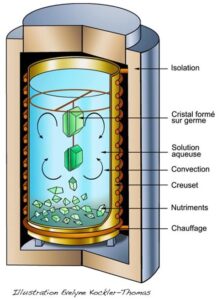
Hydrothermal dissolution is based on growth from solution in an autoclave. This chemical crystallisation aims to imitate a natural supersaturation process observed in saltwater seas, a process capable of growing many crystals. The top of the autoclave contains seeds and the bottom contains the starting, or parent, material. The lower section is hotter, causing hydrothermal fluid to move towards the seeds, where it cools and becomes supersaturated, allowing crystals to grow around them. As in any thermal system heated from below, a thermal gradient develops, creating vertical convection and continual enrichment of the hydrothermal fluid. Nucleation — the spontaneous appearance of crystals — may also occur in the autoclave; this resembles natural crystallisation processes in geodesor druses under the action of the Earth's hydrothermal fluids. Unlike anhydrous dissolution, water acts as the solvent. The constituents of the crystal to be synthesised are dissolved in a heated, pressurised alkaline aqueous solution around one or more seeds suspended on platinum wires, with convection enriching the system. One or more colouring agents are added, such as chromium, iron, nickel, cobalt, vanadium, manganese or neodymium.
The two main synthetics produced by this method are beryl and Quartz. Chromium-bearing beryl of the emerald variety is grown at 500 to 620°C and a pressure of 700 to 1,400 bars. Production costs for these emeralds and beryl in general, including red beryl or bixbite, are relatively high because growth is very slow: just 3 to 10 millimetres per week! These different synthetic emeralds sometimes bear the name of the scientist or company responsible, such as Crescent Vert, Emerita, Inamori, Regency, Linde, Biron or Malossi. Hydrothermal synthetics can be recognised by sawtooth or chevron growth markings, straight colour zones, nail-shaped cavities with ‘breadcrumb’ heads, white, beige, brown or almost black ‘breadcrumb’ inclusions, flattened or contracted fluid inclusions, ‘fingerprints’ or healed fissures described above as jardins, multiple veils or platinum wires, and Phenakite as crystals or ‘breadcrumbs’
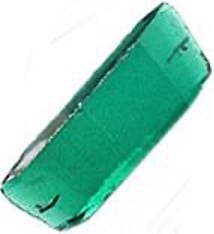
Hydrothermal emerald
of Russian manufacture
56-carat single crystal
D. Albert collection
Photo © Gemmo.eu
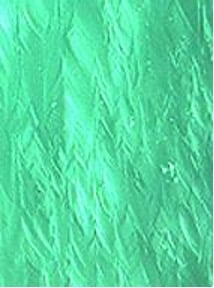
Chevron structure
or sawtooth pattern
in hydrothermal emerald.
Collection: Gems-Plus.com
Photo © Gemmo.eu
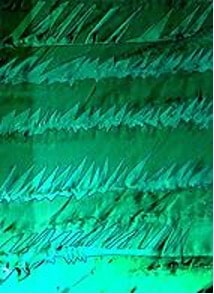
Sawtooth
structure in
hydrothermal emerald,
Illustration
© E. Kockler-Thomas
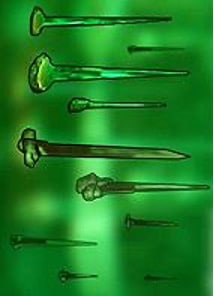
Phenakite ‘nails’
in emerald
grown hydrothermally
Illustration
© E. Kockler-Thomas

Solid flux within the material
©Thierry Pradat
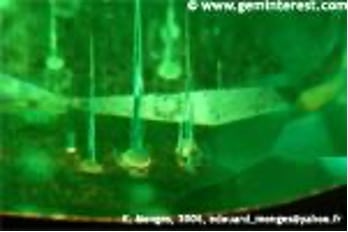
Phenakite
©Thierry Pradat
Flux synthesis: history and characteristics
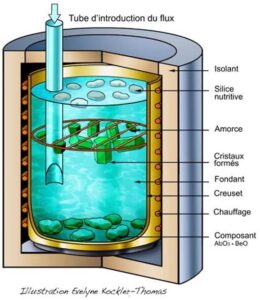
Anhydrous-solution growth has always been the preferred method for obtaining these crystals. The first confirmed beryl synthetics were obtained by Paul Hautefeuille (1836–1902), professor of mineralogy at the Paris Faculty of Sciences. With his colleague H. Perrey, he established that the best salts should consist of lithium oxide (LiO2), molybdenum oxide (MoO3) and, optionally, vanadium oxide (V2O5). Using a solute reproducing beryl's composition, he obtained crystals reaching one millimetre after heating at 800 0C for two weeks. Although this process continued subsequently, it remains marginal compared with hydrothermal dissolution. The first improvement resulted from the work of the French chemist Jacques Joseph Ebelmen, born in 1814 and deceased in 1852, who discovered that a boric-acid- or borax-based flux produced better crystals. In 1888, Paul Gabriel Hautefeuille (1836–1902) and Adolphe Jean Edme Perrey developed a new lithium-molybdate flux. This technique was followed in 1911 by the German company IG-Farbenindustrie AG, whose process for producing opaque to translucent emerald crystals 20 mm long in 12 months is shown above, using a lithium-molybdate and vanadate flux. From then until 1985, the production technique was improved, notably by the American Carroll C. Chatham in 1959, the French Pierre Gilson in 1963 and the Japanese Kyocera (Inamori) laboratory in 1978. The components of the desired synthetic gem, an optional seed, nutrient silica, a colouring agent and an anhydrous — water-free — flux are placed in a platinum crucible. They are heated at ambient pressure to the temperature at which dissolution and recrystallisation into emerald single crystals occur. The flux is most often based on lithium molybdate, following the technique developed in 1888. Slow cooling causes crystals to form and grow towards the platinum grid, or seed. Various modifications and other fluxes can be used, including lead fluoride; bismuth, lead or vanadium oxide; sodium borate or carbonate; and many others mentioned above. Production costs are relatively high because the complete process is lengthy, taking up to a year for the largest crystals. This is why hydrothermal synthesis is the preferred method for producing this green beryl, also because the resulting inclusions — the ‘jardin’ — give it a realistic appearance: emeralds are generally heavily included owing to their low toughness. In flux-grown synthetics, inclusions again include healed fissures; distorted, contracted or elongated bubbles; two-phase and rarely three-phase inclusions; stress zones; platinum as acicular or tabular, sometimes hexagonal inclusions; and recrystallised beryl within beryl.
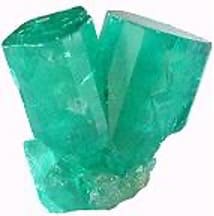
Synthetic emerald
manufactured by Chatham
approximately 7 carats
F. Hargous collection
Photo © Gemmo.eu
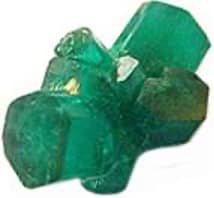
Synthetic emerald
manufactured by Gilson
5.80 carats
Gilson collection
Photo © Gemmo.eu
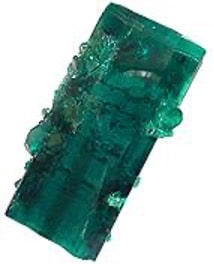
Synthetic emerald
manufactured by Gilson
large 435 ct crystal
Gilson collection
Photo © Gemmo.eu
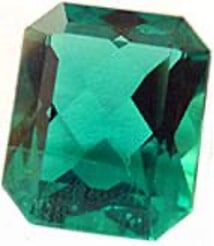
Synthetic emerald
manufactured by Gilson
4.05 carats
Gilson collection
Photo © Gemmo.eu
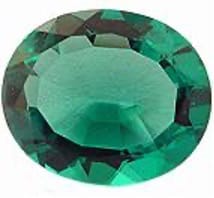
Synthetic emerald
manufactured by Gilson
4.20 carats
Gilson collection
Photo © Gemmo.eu
Note how the photographs above illustrate the manufacturing quality of each producer, each giving a particular colour, clarity and, above all, a noticeably different weight.
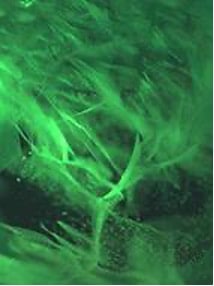
Veils in
flux-grown emerald,
all manufacturers
Illustration
© E. Kockler-Thomas
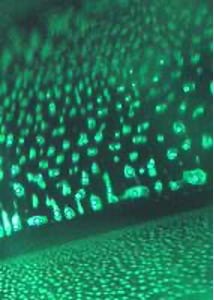
Shrinkage bubbles in
flux-grown emerald,
all manufacturers
Illustration
© E. Kockler-Thomas
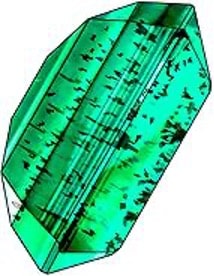
Black grains and
straight zones in emerald
manufactured by Lennix
Illustration
© E. Kockler-Thomas
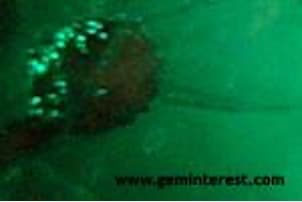
Inamori manufacture, anhydrous-dissolution process: solid inclusion consisting of a beryl seed, with the appearance of a ‘crystal on platinum wire’.
Darkfield and oblique illumination, 15×.
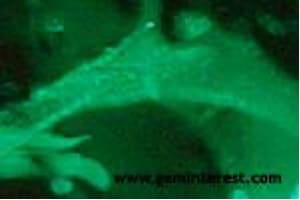
Inamori manufacture, anhydrous-dissolution process: solid inclusion consisting of residual flux grains, with a ‘veil’ appearance.
Darkfield, 45×.

Gilson manufacture, anhydrous-dissolution process: solid and/or liquid inclusion consisting of residual flux, with a ‘network, feather or veil’ appearance.
Darkfield illumination, 30×.

Chatham manufacture, anhydrous-dissolution process: solid inclusion consisting of flux residues, with an ‘undulating veil’ appearance.
Darkfield illumination, 45×
As for manufacturers, this is once again an international production method. Some of the best-known are:
-In the USA: Bell Telephone Labs, Union Carbide, Linde Crystal Products, American Elements, Creative Crystals, Chatham Research Lab, Kashan and Ramaura.
-In Russia: the Novosibirsk Institute of Geology and Geophysics, Miracrys and others.
-In Germany: IG-Farbenindustrie AG, Nacken and Zerfass.
-In France: ICMCB, Établissements Céramiques Pierre Gilson and Lennix.
-In Japan: Seiko, Kyocera, Inamori, Katsuhiro Teraishi, Seikosha and Nakazumi Earth Crystals.
-In Austria: Knischka and Lechleitner.
-In Greece: Douros.
Conclusion
The known methods of synthesising emerald result from years of research into other subjects, such as quartz for wartime use. Both hydrothermal and flux synthesis were developed to manufacture other crystals; producing this beryl is simply an offshoot of the two methods. It has proved so successful that its deceptive appearance creates difficulties for many gemmologists. As emerald becomes increasingly rare, these synthetics remain good alternatives for prospective buyers unable to afford beautiful stones of more than 5 ct with a fine emerald-green colour, don't they?
Bibliography
Thank you to the authors of all these works:
– P. BARIAND & J.-P. POIROT, Larousse des pierres précieuses, Larousse-Bordas, Paris, 1998
– J.-C. BOUILLIARD, Et l’homme créa la pierre. Les synthèses de cristaux, Mineral Collection / Université Pierre-et-Marie-Curie, Paris, 1996
– S. MEUNIER, Les Méthodes de synthèse en minéralogie, Baudry, Paris, 1861
And to the following schools:
-L’École des gemmes
– The Gemmological Association of Great Britain
-Le Laboratoire Français de Gemmologie
And to the developers of these websites:
-CNRS
-Gemmo.eu
-Geminterest
-Wikipedia
-Universalis
Laurence LeLay