Blog
Captivating inclusions in demantoid garnets


INTRODUCTION
Andradite is a mineral species in the silicate group, nesosilicate subgroup and garnet family, with the formula Ca3Fe2(SiO4)3 and traces of Ti, Cr, Al and Mg. Three specific andradite varieties can be distinguished: topazolite, melanite and demantoid garnet. Initially, only the black melanite variety was known, but it was not thought to belong to the garnet family. The name andradite was given to melanite in 1868 in honour of José Bonifácio de Andrada e Silva, a professor of mineralogy and founder of the School of Mines in Ouro Preto, Brazil; it was also recognised as belonging to the garnet family at that time. This dissertation focuses on andradite of the demantoid garnet variety, distinguished from other andradites particularly by its colour, ranging from yellow-green to intense emerald green. By comparison, topazolite and melanite are brown and black respectively and therefore much less attractive. The aim is to compare the different inclusions found in demantoid garnet according to deposit type.
I. The history of demantoid garnet
• The discovery of the Tsars' garnet.
Demantoid garnet was discovered in the late nineteenth century, more precisely in 1853, in Russia's Ural Mountains. It was found in an alluvial deposit about 110 km from Ekaterinburg along the Bobrovka River. It was initially identified as peridot until, about ten years later, the Finnish mineralogist Nils von Nordensheld discovered that it was actually a variety of green andradite. Its name means ‘diamond-like’, referring to its high dispersion.
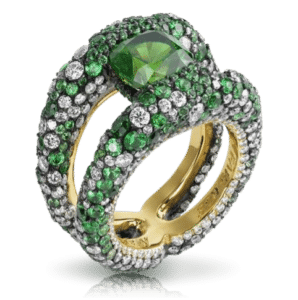
This stone was highly prized by Russian collectors and nobles, notably the jeweller Fabergé, who created Fabergé eggs covered with demantoid garnets. The House of Fabergé still uses demantoid garnets in its creations, as shown alongside. Demantoid garnet is also frequently found in Victorian-period jewellery in France and England.
Demantoid garnet remained active on the market until the Russian Revolution in 1917, with activity resuming from 1990.
Demantoid garnets were found in Val Malenco, Italy, from the late eighteenth century. These well-formed rhombic or dodecahedral crystals rarely exceed 2 or 3 carats. They occur in asbestos mines between Dossi di Franscia and Coston d'Acquanegra, at altitudes between 1,800 and 2,200 m. The presence of asbestos forced the mine's owners to close it.
Gem-quality demantoids from Namibia appeared in 1996 with the opening of the Green Dragon Mine. The deposit lies in the Erongo region, which continues to produce commercial-quality gem demantoid in quantity, with annual production of between 5,000 and 10,000 carats. Garnets often do not exceed 3 or 4 carats, although exceptional pieces can be found, such as a 46-carat crystal.
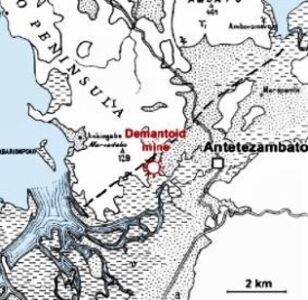
A new deposit was discovered near Ambanja in northern Madagascar in late 2008. It lies in a mangrove area 2.5 km from Antetezambato and 5 km from the coast. Access is difficult, particularly during the monsoon season.
At least 10% of the demantoid garnets found are of gem quality. Most demantoid garnets found in Madagascar are well formed, with magnificent lustre and colour. Specimens can reach an extraordinary size of more than 8 carats.
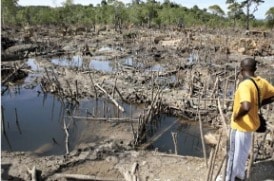
Garnets were subsequently found in the Bagh region of Pakistan's Balochistan province. These range from vivid green to yellowish green.
Gem-quality demantoid garnets were also found in Iran.
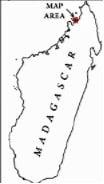
Location of the andradite deposit in northern Madagascar
@Frederico Pezzotta
• The different demantoid garnet deposits
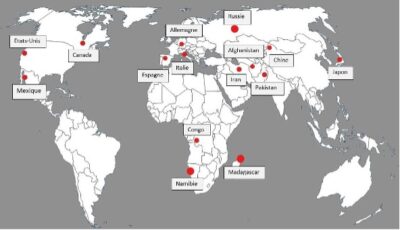
The map above shows the different deposits and places where demantoid garnets have been found, in small or large quantities. The three largest historical or current sources are Russia, Namibia and Madagascar. Iran, Pakistan and Italy also have important deposits. All the others are secondary deposits, with very low yields or very occasional demantoid garnet discoveries.
Here are some examples of garnets found there:
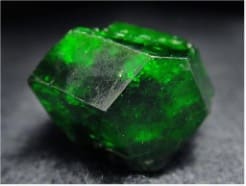
Soghan, Baft County, Kerman Province.
IRAN
@Lopatkin Oleg
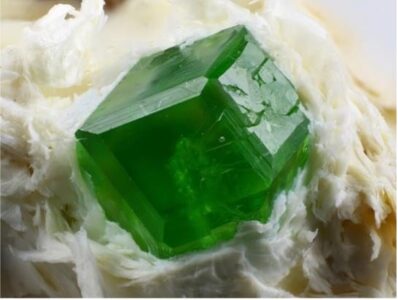
Demantoid garnet on an asbestos matrix. Malenco Valley.
ITALY
@Chinellato Matteo
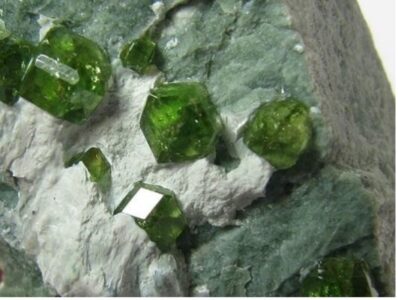
Jeffrey Mine, Asbestos, Estrie, Quebec
CANADA
@Roger Lang 2009
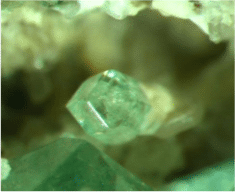
Demantoid garnet dodecahedron on a schist matrix, Ghazni Province, AFGHANISTAN
@Rob Lavinsky & Irocks
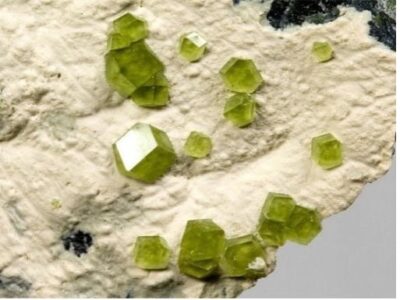
Demantoid garnet on sepiolite, Münchberg Metamorphic Complex, Bavaria, GERMANY
@Conny Larsson
II. The properties of demantoid garnet
• Structure and composition of demantoid garnets.
Garnets comprise a large group of fifteen isometric or cubic rock-forming minerals. Only six are important: pyrope, spessartine, almandine, andradite, uvarovite and grossular.
Andradite, Ca3Fe2(SiO4)3, belongs to the cubic system and forms a series with two others: the grossular series, Ca3Al2(SiO4)3, and the schorlomite series, Ca2 (Ti4+Fe3+)3O12. Garnets consist of three silicate groups associated with divalent and trivalent metal cations, with the general formula X3Y2(SiO4)3, in which the chemical elements can vary. This is therefore an isomorphous series.
The chemical elements that can substitute for X and Y form two isomorphous series: the pyralspites on one side and the ugrandites on the other.
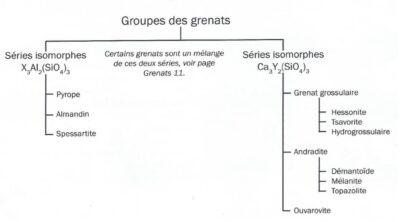
@Gem-A
Garnets are calcium and iron nesosilicates formed from isolated, unconnected [SiO4] tetrahedra. A three-dimensional network of octahedra and tetrahedra shares corners made up of oxygen atoms.
In the first, ‘pyralspite’ series, X may be replaced by magnesium (Mg), iron (Fe) or manganese (Mn). Y can only be replaced by aluminium (Al).
In the second, ‘ugrandite’ series, X is always replaced by calcium (Ca). Y may represent chromium (C), iron (Fe) or aluminium (Al).
Demantoid garnet is therefore an andradite variety within the ugrandite isomorphous series, with the formula Ca3Y2(SiO4)3.
• Gemmological properties
|
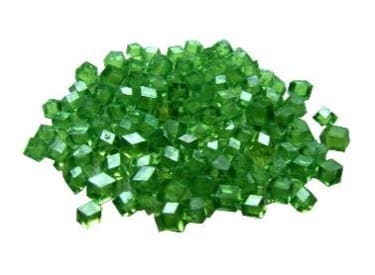
Demantoid garnet |
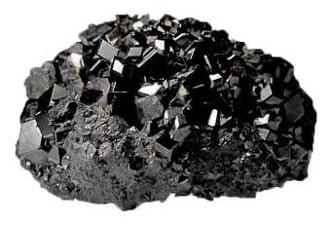
Melanite |
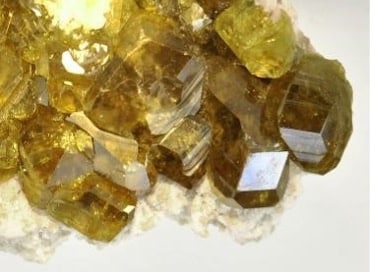
Topazolite |
|
 |
 |
 |
|
|
Colour |
Yellow-green to intense green |
Black |
Yellow to brown |
|
lustre |
Adamantine |
Adamantine |
Adamantine |
|
Transparency |
Transparent to opaque |
Opaque |
Transparent to translucent |
|
Refractive index |
1.881 to 1.888 |
1,89 |
1,887 |
|
Crystal system |
Cubic |
Cubic |
Cubic |
|
Optical character |
Isotropic |
Isotropic |
Isotropic |
|
Dispersion |
0,057 |
None |
0,057 |
|
Hardness |
6.5 to 7 |
6.5 to 7 |
6.5 to 7 |
|
Colouring element |
Iron + trivalent chromium impurity |
Iron and titanium |
Iron and titanium |
|
Chelsea filter |
Red to pinkish |
Inert |
Inert |
|
Specific gravity |
3.82 to 3.91 |
3,9 |
3.82 to 3.85 |
|
Deposits |
Russia, Italy, Pakistan, Madagascar |
Mali, Namibia, China, Thailand |
California, Romania |
Andradite is the garnet variety with the lowest hardness, at 6.5 rather than approximately 7.25. This explains why abraded facet edges may occur and why the stones are generally not large.
• Causes of colour
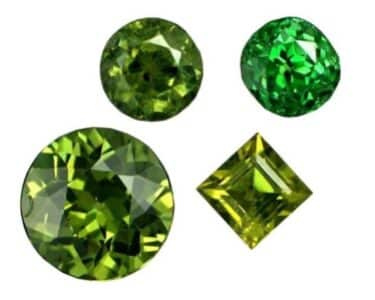
The green colour that makes demantoid garnet so exceptional comes from iron (Fe) combined with trivalent chromium impurities as Cr3+ in octahedral coordination, only in demantoid garnets from serpentinite. The higher the chromium concentration, the more intense and saturated the green colour. The almost pure andradite end member displays a yellow-green to green colour owing to iron ions.
As these three spectra show, chromium content influences the appearance of the chromium spectrum. Iranian demantoid garnets, with their very green colour and therefore higher chromium concentration, show a chromium spectrum that is not visible in most demantoid garnets. Demantoid garnets from skarns, however, contain no chromium compared with Iranian and Pakistani demantoids, which have very high concentrations. Iranian and Pakistani garnets contain up to 9,000 ppm chromium, whereas Russian and Italian garnets contain 3,000 to 4,000 ppm, as shown in the accompanying diagram.
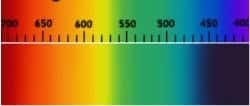 Demantoid garnet showing no specific spectrum.
@Geminterest
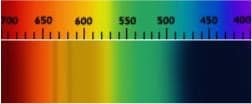 Iranian demantoid garnet showing the chromium spectrum with two weak bands, one at 645 nm and another at 618 nm.
@Geminterest
The presence of trace titanium and iron can also cause charge transfer:
Fe2+ -O- Ti4+.
This charge transfer can weaken demantoid garnet's green colour by adding a brownish-yellow colour, resulting in topazolite.
III. The formation of demantoid garnet
All demantoid garnets originate through metamorphism. Metamorphism is recrystallisation without melting. In other words, rocks in the Earth's crust and mantle can be re-formed by the temperatures and pressures present there. Depending on temperature, pressure, the nature of fluids and the chemical composition affecting the metamorphic rock, changes may be mineralogical, textural, chemical or structural. Chemical elements are reorganised within the rock and minerals recrystallise. There are two different types of metamorphism.
➢ The first is contact metamorphism, a surface process that occurs when the temperature of the surrounding rock rises as magma passes through it. When very hot magma intrudes into a sequence of cold rocks, heat is transferred and the surrounding rock is baked along its margins. Heat transforms its minerals, producing a metamorphic rock.
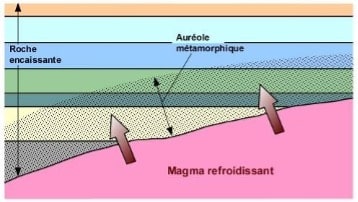
This altered margin is called a metamorphic aureole. Its width depends on the size of the intrusive mass and may vary from a few millimetres to several kilometres.
➢ The second is regional metamorphism, which occurs at depth and is much more extensive. It takes place when pressure and temperature rise substantially. Mountain ranges owe their existence particularly to this type of metamorphism, caused by the convergence of two plates. Regional metamorphism involves three main transformations: intense deformation of the rock, development of metamorphic minerals and, finally, development of metamorphic foliation. During foliation, crystals or particles in an igneous or sedimentary rock are flattened and stretched into alignment along foliation planes under the effects of pressure and temperature.
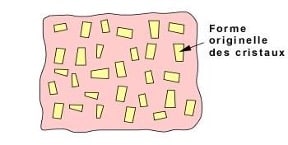
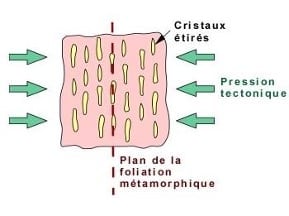
Metamorphic foliation process, with crystals aligned along foliation planes.
• Demantoid garnets formed through hydrothermal metamorphism:
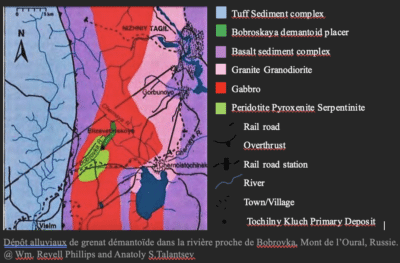
Demantoid garnets formed through hydrothermal metamorphism come from Russia, Italy, Iran and Pakistan. Hydrothermal metamorphism occurs during regional metamorphism. As explained above, oceanic and continental crust meet. Under pressure, the oceanic plate slides beneath the continental plate: this is subduction. Subduction allows hydrothermal fluids to rise, causing the alteration of peridotites. Metamorphism involving fluids containing less than 10% carbon dioxide favours serpentinisation through a chlorite–serpentinite–amphibole assemblage.

In each deposit, garnets take up the ions available in their surroundings, which may vary considerably. Serpentinite is a rock composed of olivine, pyroxene (enstatite), serpentinite (brucite, antigorite, lizardite), magnetite, chlorite and chrysotile. Demantoid garnet can form from water rich in iron, calcium and silica supplied by the various components of serpentinite. Magnetite and chromium-rich magnetite are common components in demantoid garnets associated with serpentinites, which may explain their more intense green colour. These garnets formed at low temperatures, between 300 and 400°C.
• Demantoid garnets formed through metasomatism:
Metasomatism is the chemical transformation of a rock by hydrothermal fluids. In other words, one mineral is replaced by another within the rock, atom by atom and molecule by molecule. Skarns are metamorphic rocks resulting from chemical metasomatism in the contact zone between an igneous and a sedimentary rock. Demantoid garnets from Madagascar and Namibia occur specifically in skarns. Here again, the chemical environment allows garnet to form: limestone supplies calcium, sandstone supplies silica and igneous rock supplies the necessary iron.
This type of deposit is characterised by the intrusion of a felsic alkaline pluton. At Antetezambato, for example, deposits are associated with granite intrusions and trachytic dykes. The trachytic dykes penetrated sedimentary formations enclosed by a succession of sandstone, limestone and mudstone.
In Namibia's Erongo Mountains, deposits occur in a metamorphosed sequence transformed into successive schists, calc-silicate rocks and marbles. Demantoid garnet occurs in this marble and in the calc-silicate rocks between the dykes and igneous plugs.
Demantoid garnet can occur in different geometric structures. In Russia, it is found in lenses within serpentinites. At Bagh Borj, it occurs as botryoidal clusters or euhedral crystals in lenses of asbestos rock within serpentinites. It can also occur in talc-rich lenses, as at Kaghan, associated with magnetite and ludwigite.
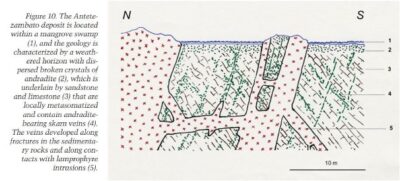
Demantoid garnet deposit, Madagascar @Frederico Pezzotta
IV. Inclusions
As shown in the previous section, demantoid garnets originate either through hydrothermal metamorphism or through a contact-metamorphic process known as metasomatism. The geological environment in which garnets form varies with the type of metamorphism.
Type I demantoid garnets originate in ultramafic serpentinite rock deposits through hydrothermal metamorphism. These are the garnets of Russia, Italy, Iran and Pakistan.
Type II demantoid garnets originate in skarn-type metamorphic deposits through metasomatism. These include garnets from Namibia and Madagascar.
• Inclusions in Type I garnets
When the first demantoid garnets were discovered, curved fibrous inclusions were observed inside them and initially mistaken for byssolite. Mineralogists later realised they were chrysotile. This type of inclusion was initially thought specific to the Russian deposit. After demantoid garnets were discovered in Italy, Iran and Pakistan, however, it became clear that ‘horsetail’ inclusions were not diagnostic of Russian garnets but inherent to the deposit type. This inclusion can occur in any demantoid garnet from a hydrothermal metamorphic serpentinite deposit.
These Type I garnets formed in ultramafic rocks mainly composed of magnetite, diopside, antigorite and serpentinites. Demantoid garnets from this deposit type are hosted by chrysotile — asbestos — generally oriented perpendicular to the foliation. This allows fibrous inclusions of the same material to occur within the garnets.
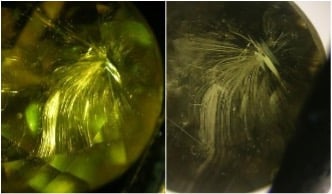
Solid chrysotile inclusion = curved horsetail, 45×
RUSSIA
@Geminterest
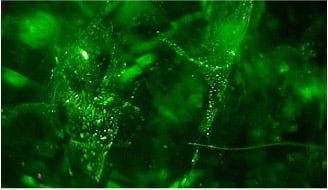
Liquid inclusion: veil-like healed fissure, 45×
IRAN
@Geminterest
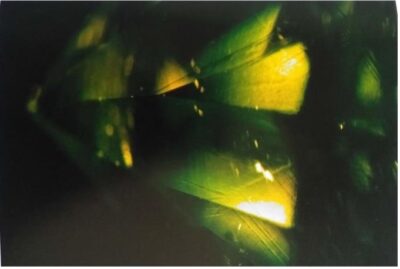
Demantoid garnet showing internal traces of crystal faces
IRAN
DF FO 50×
@Photo Atlas
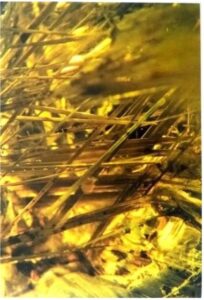
Sometimes, diopside channels completely replace the chrysotile fibres and dominate the interior of demantoid garnets.
RUSSIA
DF 16×
@Photo Atlas
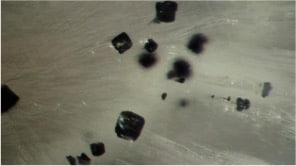
Deep black magnetite inclusions and chrysotile fibres.
PAKISTAN
@Nathan Renfro
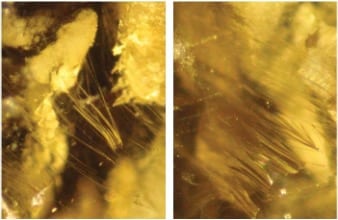
Fibrous chrysotile inclusions typical of serpentinite deposits
ITALY
@Vanda Rolandi
Laser Raman spectroscopy (LRS) can be used to determine the nature of inclusions in demantoid garnets. This instrument uses an infrared, visible-light or ultraviolet laser beam. The Raman spectrometer detects an extremely small re-emission of energy, recorded as an emission spectrum. The spectrum is characteristic of individual molecules and allows rapid identification of solid or liquid substances, even when enclosed in another transparent material, as with the diopside shown alongside.
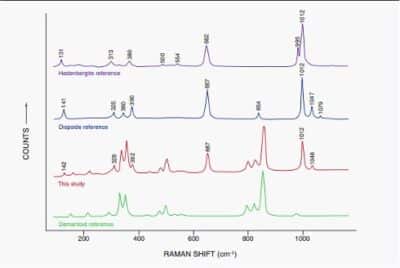
@Michael S. Krzemnicki
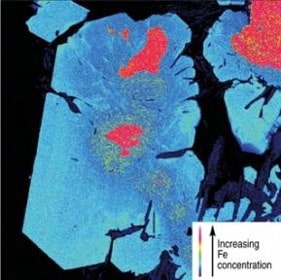
X-rays allow inclusions within a demantoid garnet to be observed, as shown alongside. These images come from the GIA scientific article:
‘DEMANTOID FROM VAL MALENCO, ITALY: REVIEW AND UPDATE’
• Inclusions in Type II garnets
Type II garnets originate through metasomatism. Horsetail inclusions do not occur in this type of demantoid garnet because the chemical environment does not allow them. As described above, Type II deposits are characterised by the intrusion of a felsic alkaline pluton or volcanic rocks into rocks containing calcium (Ca) and magnesium (Mn). Gemstones from skarns
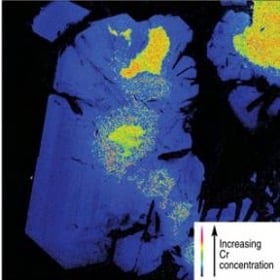
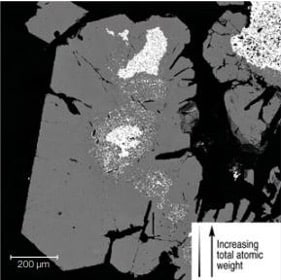
The white areas in the backscattered-electron image at the lower left are chromium-bearing magnetite inclusions. The X-ray maps in the centre and on the right show the distribution of Fe and Cr in the inclusions and in the host garnet from Val Malenco, Italy.
@Ilaria Adamo, Rosangela Bocchio, Valeria Diella, Alessandro Pavese, Pietro Vignola, Loredana Prosperi, and Valentina Palanza
display a wider range of inclusions, including two-phase inclusions, fluids, diopside, pyrite, calcite and sphalerite.
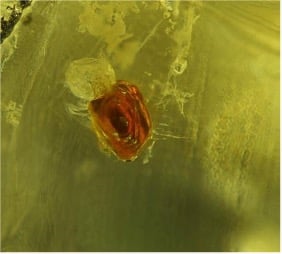
Orange sphalerite inclusion in a demantoid garnet, accompanied by a diopside sphere attached to the sphalerite and a calcite inclusion on the right.
NAMIBIA
@Aaron Palke
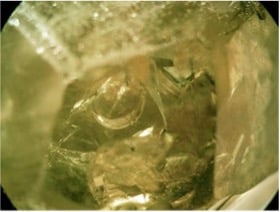
Two-phase inclusion in a demantoid garnet with a bubble measuring almost 2 mm.
MADAGASCAR
@Michel Cathelineau
CONCLUSION
Demantoid garnet is an exceptional stone that inspires enthusiasm among collectors and jewellers alike. Understanding the processes that create inclusions is very important, as is knowing which inclusions can occur in this fabulous stone. We have therefore dispelled the myth that chrysotile inclusions are specific to Russian demantoid garnets.
20
BIBLIOGRAPHY:
Websites:
-
• Mindat.org
-
• Facebook: Demantoid Ural
-
• Expert Diamond, ‘Grenat démantoïde FR’
-
• Geminterest, ‘Andradite: Grenat démantoïde’.
-
• Wikipedia.
-
• GIA
-
• Gem-A
Articles:
-
• ‘Large Namibian demantoid garnet’. Duncan Pay. Gems & Gemology.
-
• ‘Demantoid – From the Ural Mountains of Russia’. Gabriel Mattice. Vol. 4, No. 1–
1998
-
• ‘Diopside needles as inclusions in demantoid garnet from Russia: A Raman
microspectrometry study’. Michael S. Krzemnicki – 1999
-
• ‘Gem Andradite Garnet Deposits Demantoid Variety’. In Gems, by Gaston
Giuliani, Isabella Pignatelli, Anthony Fallick, Adrian Boyce, Alfred
Andriamamonjy, Sitraka Razafindratsimba and Tahseenullah Khan.
-
• ‘Demantoid and Topazolite from Antetezambato, Northern Madagascar: Review
and new data’. G&G. Frederico Pezzotta, Ilaria Adamo and Valeria Diella. 2011
-
• ‘Demantoid from Balochistan, Pakistan: Gemmological and Mineralogical
Characterization’. Ilaria Adamo, Rosangela Bocchio, Valeria Diella, Franca
Caucia and Karl Schmetzer. 2016
-
• ‘Demantoid from Baluchistan, Province in Pakistan’. Aaron C. Palke and Vincent
Pardieu. Gems & Gemology, Winter 2014, Vol. 50, No. 4.
-
• ‘Demantoid Garnet with Giant Fluid Inclusion’. Gaston Giuliani, Marie-Christine
Boiron, Christophe Morlot, Julien Raoul, Pierre-Yves Chatagnier. Gems &
Gemology, Winter 2015, Vol. 51, No. 4.
-
• ‘Russian Demantoid, Czar of the Garnet Family’. Wm. Revell Phillips and Anatoly
S. Talantsev. Gems & Gemology. Summer 1996.
-
• ‘Demantoid From Val Malenco, Italy: Review Update’. Ilaria Adamo, Rosangela
Bocchio, Valeria Diella, Alessandro Pavese, Pietro Vignola, Loredana Prosperi and Valentina Palanza. Gems & Gemology. Winter 2009
Dissertation:
-
• Mr Pierre-Yves Chatagnier, ‘Le traitement thermique de l’Andradite’. 2012, Gem-Nantes
21
Books:
-
• La grande encyclopédie des minéraux. Gründ, 1987
-
• Guide Delachaux: Pierres précieuses et ornementales
-
• Photo Atlas of Inclusions in Gemstones. Vol. 2. E. J. Gubellin & J. L. Koiwula