Blog
Corundum: an exceptional family of gems


Few minerals can claim to have given rise to two of the world's most famous gemstones. Yet ruby and sapphire are simply two faces of the same mineral species: corundum. Behind this apparent simplicity lies a family of gems whose rich colours, physical properties and history fascinate scientists and jewellers alike.
Long associated with sovereigns, religious treasures and great dynasties, corundums are among the most sought-after stones in high jewellery. Ruby, with its intense red, has symbolised passion and power for centuries, while sapphire, found in almost every colour, evoked wisdom, fidelity and serenity in the medieval period. Their exceptional hardness, second only to diamond, allows them to endure for centuries without losing their lustre.
Even today, the finest corundums rival diamonds at major auctions, while their physical qualities also make them essential materials in many industrial fields.
Composition and structure
Corundum is an aluminium oxide with the chemical formula:
Al₂O₃
It crystallises in the trigonal system, generally as stout prisms, bipyramids or barrel-shaped crystals. In some deposits, crystals can reach several tens of centimetres, although fully gem-quality specimens remain much rarer.
In its pure state, corundum is colourless. The colours that made its reputation come solely from small quantities of elements present during crystallisation.
Chromium produces ruby's characteristic red. The combination of iron and titanium gives rise to the famous blue sapphires, while iron alone can generate yellow, green or brownish shades. Vanadium is responsible for certain purple hues, and particular concentrations of chromium and iron produce the very rare padparadscha sapphires, with their delicate pink-orange colours.
With a hardness of 9 on the Mohs scale, corundum is the second-hardest natural mineral after diamond.
This remarkable resistance explains its success in jewellery, where it withstands daily wear exceptionally well while retaining its polish over time.

Size: thumbnail, 3.0 × 1.4 × 1.2 cm
A family of gems
The term corundum describes a single mineral species, but gemmological tradition distinguishes several varieties according to colour.
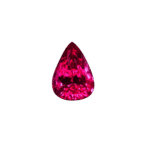
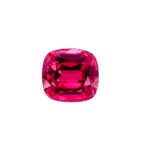
- The name ruby is reserved exclusively for red corundum. This colour is produced by chromium and is often accompanied by natural fluorescence that intensifies it, particularly in stones from Burma. The most sought-after rubies display the famous ‘pigeon blood’ red: a deep, luminous, slightly velvety shade that has become the market benchmark.
All other corundums are called sapphire, whatever their colour.
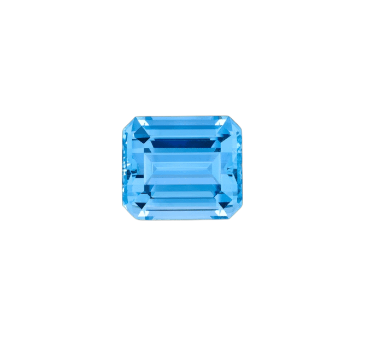
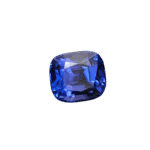
- Blue sapphire remains the best-known variety. Its colour can range from a pale, almost pastel blue to a very deep midnight blue. Kashmir stones are famous for their colour, while those from Sri Lanka generally offer lighter, brighter shades.
- Yellow sapphires, produced mainly in Sri Lanka, Madagascar or Australia, are appreciated for shades ranging from pale lemon to deep gold.
- Pink sapphires are enjoying growing success in contemporary jewellery, particularly for engagement rings. Their colour comes from a low chromium content, insufficient, however, for them to be classified as rubies.
- Green, purple, orange and colourless sapphires complete this already extensive palette.
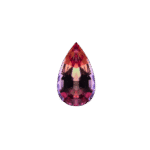
Among all these varieties, padparadscha holds a special place. Its name, derived from Sinhalese, evokes the colour of sunset. Its subtle blend of pink and orange makes it one of the rarest and most sought-after gems in the world.
Some corundums also reveal remarkable optical phenomena. When fine rutile needles are aligned in very specific directions, they produce asterism, visible as a six-rayed star when the stone is cut as a cabochon. More rarely, certain specimens also display a colour-change effect.
Corundum in history
Corundums have accompanied the great civilisations for more than two millennia.
In Asia, rubies were regarded as among the most precious stones. Burmese rulers associated them with power and invincibility, while some warriors even carried them as talismans believed to protect them in battle.
In ancient India, ruby was nicknamed the ‘king of gemstones’. Sanskrit texts attributed protective powers to it and promised prosperity and longevity to anyone who offered it to the gods.
Sapphire followed a different path. Since antiquity, it symbolised the heavens, truth and wisdom. European clergy soon adopted it to adorn their episcopal rings, convinced that it embodied purity and uprightness.
In the Middle Ages, many royal crowns were set with rubies and sapphires, although several of these stones later proved to be spinels or red garnets.
In modern times, corundums continue to enrich the most prestigious collections. The Sunrise Ruby and famous Kashmir sapphires regularly achieve records at international sales, confirming their status as exceptional stones.

Description: 1.5 cm pseudohexagonal ruby crystal in marble/calcite matrix
The world's major deposits
Corundums form in varied geological environments, mainly within aluminium-rich metamorphic rocks, but also in certain silica-poor igneous rocks. Once released by erosion, their great hardness allows them to accumulate in alluvial deposits, where they have been mined for centuries.
Rubies
The Mogok Valley, in Burma (Myanmar), remains the global benchmark for the highest-quality rubies. It was here that the famous ‘pigeon blood’ rubies were discovered, their colour still unequalled.
On Mozambique has become one of the world's leading producers in just a few years, with stones that are often very clean and richly red.
Madagascar and Tanzania complete today's main mining regions.
Blue sapphires
On Sri Lanka has produced sapphires renowned for their transparency and luminous blue for more than two thousand years.
On Kashmir, whose mines are now almost exhausted, remains the ultimate benchmark for stones with a velvety appearance.
Madagascar has become a major player in the global market since the discovery of numerous deposits in the 1990s. Australia supplies generally darker sapphires, while Montana, in the United States, produces stones with often softer shades.
Coloured sapphires
Yellow, pink, green and purple sapphires come mainly from Sri Lanka, from Madagascar, from Tanzania, Australia and Nigeria.
The very rare padparadschas are mainly mined in Sri Lanka and, more recently, in Madagascar.
Treatments, imitations and synthetics
Corundum is among the gems most frequently treated to improve their colour or transparency.
The most widespread treatment is heating. Carried out at high temperatures, it can dissolve certain microscopic inclusions, intensify colour or reduce unwanted hues. This practice is widely accepted on the market, provided it is clearly disclosed.
For several decades, certain heavily fractured rubies have also been treated by filling with lead glass. This process considerably improves their appearance but reduces their value and requires special care during jewellery repairs.
More rarely, some blue sapphires have undergone diffusion treatments, which introduce colouring elements only into the stone's surface layers. These treatments remain detectable in a laboratory.
Synthetic corundums have also been produced industrially since the early 20th century using the Verneuil, Czochralski and hydrothermal processes. They are used in watchmaking, optics and electronics as well as jewellery.
Finally, synthetic spinels, coloured glasses and certain CZ (synthetic cubic zirconia) can imitate the appearance of rubies and sapphires. Identification relies on precise gemmological criteria, particularly inclusions, absorption spectra, fluorescence and optical properties.

Corundum in contemporary jewellery
Ruby and sapphire are among the most prestigious stones in high jewellery.
Alongside diamond, emerald and blue sapphire, ruby belongs to the very select group of precious stones. Natural unheated examples weighing several carats now command exceptional values and regularly rank among the most expensive gems sold at auction.
Blue sapphire remains a timeless classic. Its success grew further following the engagement ring given to Lady Diana Spencer, now worn by Catherine, Princess of Wales. This event contributed greatly to popularising the gem with the general public.
Coloured sapphires are also enjoying a real boom. Pink, yellow or green, they appeal to customers seeking unusual stones while benefiting from corundum's inherent robustness.
At the same time, corundums retain considerable industrial importance. Their hardness and resistance enable the manufacture of high-end watch crystals, optical windows, laser components and highly precise scientific instruments, as well as abrasive materials.
A family of timeless prestige
Few minerals combine so many qualities. With exceptional resistance, remarkable colour diversity and a history spanning all civilisations, corundums hold a unique place among gemstones.
From the fiery rubies of Mogok to the velvety sapphires of Kashmir, each crystal tells a story combining geology, culture and human craftsmanship. This richness explains why corundum remains one of the most admired gem families today, among collectors, jewellers and scientists alike.
Bibliography
- Hughes, R. W. (2017). Ruby & Sapphire: A Collector's Guide. RWH Publishing.
- Nassau, K. (1994). Gemstone Enhancement. Butterworth-Heinemann.
- Giuliani, G., Groat, L. A., Fallick, A. E. et al. (2014). Rubies and Sapphires: Geology, Genesis and Deposit Types. Elements, 10(6).
- Hänni, H. A. (2009). Gemmology. SSEF Publications.
- Gemological Institute of America (GIA). Ruby and Sapphire Reference Library.
- Gem-A. Gem Knowledge Base – Corundum.
- Mindat.org. Corundum Mineral Data.
- Webster, R. (1994). Gems: Their Sources, Descriptions and Identification. Butterworth-Heinemann.