
Blog
The beryl family: crystalline elegance


When discussing the great gemstones, emerald immediately comes to mind. Yet few people know that this gem, alongside morganite, heliodor, goshenite, aquamarine and the very rare red beryl, belongs to a single mineral species: beryl.
This family holds a privileged place in gemmology. It brings together some of jewellery's most prestigious stones while offering an exceptional diversity of colours. Behind this richness lies a remarkably stable crystal structure, capable of accommodating different chemical elements that profoundly alter the stone's appearance. Just traces of chromium, iron or manganese are enough to transform a colourless crystal into a deep-green emerald or a delicate pink morganite.
Found on every continent, mined for several millennia and still highly sought-after by collectors and jewellers alike, beryl perfectly illustrates how geology can shape some of nature's most beautiful creations.
Composition and structure
Beryl is a beryllium aluminium cyclosilicate with the chemical formula:
Be₃Al₂Si₆O₁₈
It crystallises in the hexagonal system, generally forming long prisms with a hexagonal cross-section, sometimes perfectly developed. Some crystals reach several metres in length and rank among the largest natural crystals ever discovered.
Its structure consists of stacked silicate rings that form tiny channels parallel to the crystal axis. These crystals can accommodate various chemical elements or fluids, explaining both the range of colours and the presence of characteristic inclusions, particularly common in emeralds, for example.
Beryl has a hardness of between 7.5 and 8 on the Mohs scale, making it suitable for jewellery. Cleavage is indistinct, but certain heavily included varieties remain vulnerable to breakage, requiring careful cutting. This is particularly true of emeralds, whose many natural fissures make the lapidary's work especially delicate.
A family of gems
Unlike garnet, whose different species have distinct chemical compositions, beryl varieties all belong to the same mineral species. Just a few elements present in very small quantities are enough to alter their colour.
- Emerald is undoubtedly the most famous. Its intense green comes mainly from chromium, sometimes vanadium. The most sought-after stones display a deep, slightly bluish colour combined with good transparency. Inclusions are so common that they almost constitute a natural signature of the gem; gemmologists often refer to them as a jardin, or garden.
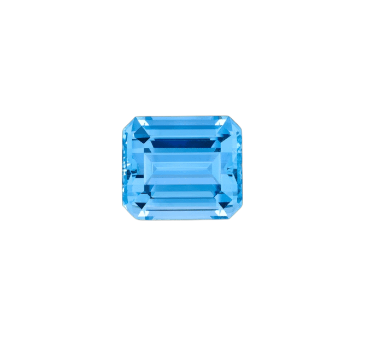
- Aquamarine owes its pale to rich blue colour to iron. Its crystals are often much clearer than emerald crystals, allowing very large stones of remarkable transparency to be cut. Some exceed several hundred carats while retaining excellent clarity.
- Coloured by manganese, morganite appeals with shades ranging from pale pink to peach. Long regarded as a mineralogical curiosity, it is now enjoying real success in jewellery thanks to its soft colours and excellent transparency.
- Heliodor, whose name evokes the Sun, displays yellow to golden shades produced by iron. Some stones show a particularly sought-after honey colour.
- Goshenite is the colourless variety. Before the arrival of modern imitations and synthetic cubic zirconia, it was sometimes used as a diamond substitute.
- Finally, red beryl, sometimes called bixbite, remains one of the rarest gems in the world. Found mainly in the US state of Utah, it owes its colour to manganese. Gem-quality crystals exceeding one or two carats remain exceptional.
This diversity perfectly illustrates the richness of the beryl family: the same crystal architecture can produce stones with completely different characters, simply through the influence of a few chemical elements present in minute quantities.

Beryl in history
Beryl's history accompanies that of the great civilisations.
Emerald has been mined for more than four thousand years. The Egyptians were already extracting it in the Eastern Desert, from deposits now known as ‘Cleopatra's mines’. The Egyptian queen was deeply fascinated by this stone, which she associated with renewal, fertility and power.
The Romans, for their part, attributed soothing properties to emerald. Pliny the Elder reported that gem engravers contemplated it to rest their eyes after long hours of work.
From the 16th century onwards, the discovery of fabulous Colombian deposits transformed the global gem trade. Spanish conquistadors brought emeralds of previously unknown quality back to Europe, where they would adorn royal treasuries and the jewels of the great European courts.
Aquamarine has a different history. Its name, derived from the Latin aqua marina, literally means ‘sea water’. Its colour evoked tropical lagoons, and sailors regarded it as a talisman capable of calming storms and protecting travellers.
More recently, morganite was discovered in Madagascar and California in the early 20th century. It was named in honour of the famous American collector and financier John Pierpont Morgan, a major patron of the natural sciences.
Beryls still hold a privileged place today in museum collections and in creations by the great jewellery houses.
The world's major deposits
Beryls form mainly in granitic pegmatites, but also in certain metamorphic or hydrothermal environments. The geological conditions governing their formation directly influence their colour, clarity and size.
Emeralds
Colombia remains the global benchmark, with the famous districts of Muzo, Chivor and Coscuez. Their emeralds display a deep, slightly velvety green that serves as a reference on the international market.
Zambia produces generally darker stones, often slightly bluish, highly appreciated for their transparency. Brazil, Afghanistan, Pakistan and Ethiopia complete today's main producing regions.
Aquamarines
For more than a century, Brazil, particularly the state of Minas Gerais, has supplied some of the world's finest aquamarines. Madagascar, Mozambique, Nigeria and Pakistan also yield large crystals, sometimes perfectly clear.
Morganites
Madagascar has become one of the main producers of gem-quality morganite, alongside Brazil, Mozambique and California, where the variety was first described.
Heliodors
The finest heliodors come from Namibia, Ukraine, Brazil and Madagascar. Their shades range from lemon yellow to rich gold.
Red beryl
Red beryl is a special case. Its only truly workable deposit lies in the Wah Wah Mountains of Utah. This extremely restricted location explains its exceptional rarity and value to collectors.


Treatments and imitations
Like many gemstones, beryls may undergo certain treatments to improve their appearance. The most common concerns emerald.
Natural fissures are often impregnated with transparent oils, traditionally cedarwood oil, to reduce their visibility and improve the stone's apparent transparency. This practice is widely accepted in the trade, provided it is clearly disclosed at the time of sale.
For several decades, certain oils have been replaced by more stable synthetic resins. Although more effective, these are still regarded as significant treatments that must be disclosed.
Aquamarines are sometimes moderately heated to remove natural greenish tones and strengthen their blue colour. This treatment is stable and accepted.
Synthetic beryls also exist, mainly emeralds. Produced by hydrothermal or flux growth, they are used both for research and for jewellery. Their identification relies on the study of inclusions, crystal growth and various gemmological analyses.
Finally, certain glass or composite imitations can reproduce the appearance of beryls. Gemmologists use refractive index, specific gravity, the dichroscope and spectroscopy to distinguish a natural stone from an imitation or a synthetic.
Beryl in contemporary jewellery
Emerald remains one of the three great precious stones, alongside ruby, sapphire and diamond. The finest specimens, combining intense colour with good transparency, command prices comparable to the most prestigious diamonds.
Aquamarine appeals through its excellent transparency and availability in large crystals. It is often chosen for rings, pendants or jewellery sets where its size can be fully appreciated.
Morganite has enjoyed a real surge in popularity over the past fifteen years or so. Its delicate pink pairs particularly well with rose gold, making it a highly appreciated stone in contemporary creations.
Less widely known, heliodor and goshenite appeal mainly to enthusiasts seeking unusual stones, while red beryl remains largely reserved for major gemmological collections because of its extreme rarity.
Beyond their commercial interest, beryls also offer mineralogists a remarkable field of study. Their inclusions often allow the geological conditions present during their formation to be reconstructed, making each crystal a true witness to the Earth's history.
A family of remarkable diversity
Few minerals offer such a palette of colours while retaining an identical structure. From the deep greens of emeralds to the clear blues of aquamarines, the delicate pinks of morganites to the luminous yellows of heliodors, beryls illustrate how traces of a few chemical elements can transform the same mineral into gems with distinctly different identities.
This diversity, combined with a long history, deposits across several continents and remarkable gemmological qualities, explains the privileged position this family holds in the world of gemstones. An object of scientific study, a source of wonder for collectors and an exceptional material for jewellers, beryl remains one of the most beautiful expressions of the mineral world's richness.
Bibliography
- Groat, L. A., Giuliani, G., Marshall, D. D. & Turner, D. C. (2014). Emerald Deposits and Occurrences: A Review. Geological Society of America.
- Sinkankas, J. (1981). Emerald and Other Beryls. Chilton Book Company.
- Nassau, K. (1994). Gemstone Enhancement. Butterworth-Heinemann.
- Giuliani, G. et al. (2000). ‘Oxygen Isotope Systematics of Emerald.’ Mineralium Deposita, 35(8), 673-691.
- Gemological Institute of America (GIA). Beryl, Emerald and Aquamarine Reference Library.
- Gem-A. Gem Knowledge Base – Beryl Group.
- Mindat.org. Beryl Group Mineral Data.
- Handbook of Mineralogy. Beryl. Mineralogical Society of America.