Blog
Jade: its importance and methods of identification


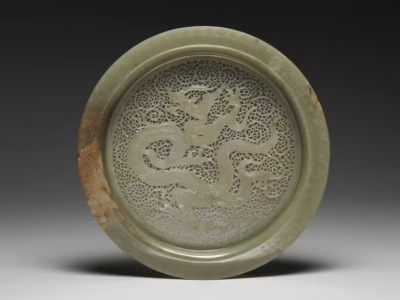
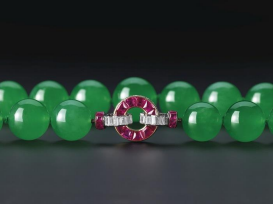
Françoise Li-de Vries — December 2017 — Diploma project — Jade: its importance and methods of identification
CONTENTS
Introduction
Part One: the definition and importance of jade
- Historical background
- Mineralogical characteristics of jadeite jade and nephrite jade
- Jade quality criteria — Sources
Part Two: methods of identifying jade
- Classification of Type A, B and C jades
- Conventional identification tests
- Laboratory tests
Conclusion
Introduction
Virtually unknown in Europe until the nineteenth century, jade was often confused with the quartz varieties jasper and chalcedony. The Spanish, who brought it from the Americas, called it ‘piedra de ijada’ (‘kidney stone’ or ‘flank stone’). The French term derived from this became ‘pierre de l'éjade’, then, through a change in pronunciation, jade, which first appeared in the Dictionnaire général in 1667. The earliest jade objects date from the Neolithic period, around 5000–7000 BC.
In China and also in Korea, jade symbolises much more than a rare gem: it represents power, high social status and virtue. Jade, the ‘stone of Heaven’, was also used to connect heaven and earth through funerary objects such as urns or small sculptures placed beside the dead to ward off evil and immortalise their souls. The pierced discs, or bi, represent heaven.
The first part of this work addresses the definition and importance of jade, its historical background, mineralogical characteristics, quality criteria and, finally, its sources. We will not discuss the jade of the Māori peoples here, although it is essential to their culture. A second part will detail methods of identifying jade, including the classification of Types A, B and C and conventional and laboratory identification tests.
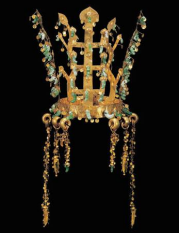
Crown, Silla kingdom, second half of 5th century, gold and jade, excavated from the north mound of Hwangnam Daechong Tomb, 10 3/4″ / 27.3 cm high (Gyeongju National Museum, Korea, National Treasure 191
JADE TECHNICAL DATA
JADEITE JADE
Group / family: Pyroxene Chemical class: Silicate Chemical formula: Na(Al,Fe3+)Si2O6 Composition: Sodium, aluminium and iron silicate Crystal system: Monoclinic Optical character: B+ Hardness: 7 Specific gravity: 3.30 to 3.36 Refractive index: 1.650 to 1.666 Birefringence: 0.010 to 0.016 Colour: Transparency: Rarity, rough: Rarity, cut:
NEPHRITE JADE
Group / family: Amphibole Chemical class: Silicate Chemical formula: Ca2(Mg,Fe2+)5Si8O22(OH)2 Composition: Calcium, magnesium and iron hydroxyl silicate Crystal system: Monoclinic Optical character: B- Hardness: 6.5 Specific gravity: 2.95 to 3.10 Refractive index: 1.610 to 1.660 Birefringence: 0.024 to 0.027 Colour: Transparency: Rarity, rough: Rarity, cut: (Gemmo.eu)
Part One: defining jade
Historical background
In Chinese, jade, yu, 玉, means ‘beautiful, precious, treasure’. The Chinese fascination with jade stems from the rarity and great durability — very high toughness — of this mineral, which symbolises both spiritual and temporal power. In his description of jade, Confucius (551 BC–479 BC) already gave the physical characteristics still observed today: ‘Jade is soft and pleasant… it has a fine texture but is strong… although it has edges and corners, it is not sharp…’
‘Although jade is graceful, its imperfections are also apparent… Furthermore, the colour of jade can be seen from every angle.’ Jadeite jade, with its extensive range of colours, is used in jewellery, whereas nephrite jade is more commonly found in decorative objects, sculptures or weapons. The distinction between jadeite jade and nephrite jade was established in 1863 by Augustin-Alexis Damour.
In January 1863, he presented a chemical analysis of the two types of jade to the Académie des Sciences and reached the following conclusion: ‘From what has just been set out, I believe green jade should be classified as a separate species, attached to the Wernerite family. I propose to give it the name Jadeite to distinguish it from white jade, which remains within the Amphibole family.’ White jade corresponds to nephrite jade, as found in ‘vases, cups, dagger handles, bracelets, etc.’ and ‘is attached to the Amphibole family and particularly to the species known as tremolite.’
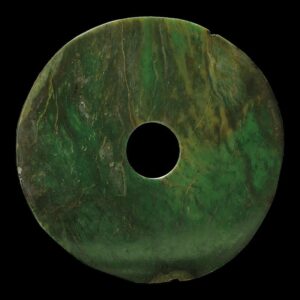 Ancient bi jade from the Neolithic period (Christie's)
Mineralogical characteristics of jade. Jadeite jade is a sodium and aluminium silicate: NaAl(SiO 3) 2, and nephrite jade is a hydroxyl silicate of calcium and magnesium or iron: Ca2 (Mg, Fe) 5 (OH, FSi4011) 2. Although it is established that jadeite belongs to the pyroxene group and nephrite to the amphibole group, points of confusion can arise in a strict analysis of the two types of gem.
Nephrite combines two distinct amphiboles. Actinolite, a calcium and ferrous magnesium silicate, forms the fibrous nephrite type with tremolite, a calcium and magnesium silicate. Nephrite jade is therefore not classified as a mineral species but as a variety of actinolite–tremolite. Jadeite jade has a complex chemical composition. As defined by Augustin Damour, jadeite jade is a mineral separate and distinct from nephrite: a sodium and aluminium silicate, NaAl(SiO3) 2.
Jadeite is structurally close to other minerals in the pyroxene group and sometimes contains high concentrations of diopside or acmite. Such specimens will nevertheless be described as jadeite if their gemmological properties are not significantly altered: refractive index, specific gravity, optical spectrum and hardness. Where the gemmological data change beyond the levels compatible with the designation ‘jadeite’, the material is called ‘diopside-jadeite’.
The structure of jadeite and nephrite materials is also decisive in distinguishing them. Although both gems must have a hard, fine-grained and compact structure — hence their great toughness — if the fibres are parallel rather than interlocked, the material cannot be nephrite but is jadeite.
Jade quality criteria
(GIA)
Colour
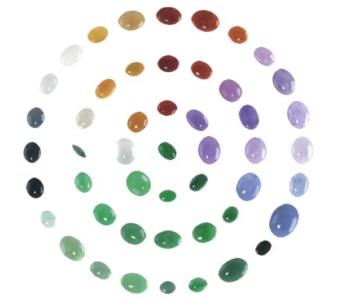
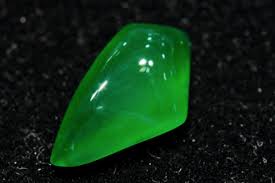
- Green is jade's best-known colour. However, it also occurs in orange-red, black, lavender and bluish shades. Imperial jade, whose colour and transparency are close to those of emerald, is the rarest and most imitated. Trace elements cause colour in jade: green, for example, comes from chromium (Cr), and yellow and yellow-green from iron (Fe). Lavender colour is attributed to manganese (Mn).
- Nephrite does not occur in the same shades as jadeite: its colours range from light green to very dark green, with shades of yellow, brown, grey (‘chicken bone’), white (‘mutton fat’ jade) and black. Iron produces brown, yellow and green hues, although green may also contain traces of chromium. White and grey nephrite jades have very little iron compared with green shades.
- Jade's transparency ranges from opaque to translucent or semi-transparent, the latter representing the rarest quality. For exceptional gems, a ‘see-through’ test can be performed.
Its texture can be described as coarse-grained, medium-grained or fine-grained.
-Coarse-grained: crystals visible to the naked eye are larger than 2 mm; the material is opaque.
-Medium-grained: crystals visible to the naked eye measure between 1 and 2 mm; the material is opaque to translucent.
-Fine-grained: crystals visible to the naked eye measure between 1 mm and 0.5 mm; the material is translucent to transparent. -Cryptocrystalline structure: the crystals measure less than 1 mm; the jade is almost transparent.
- Cut is also crucial: the finest jadeite jades are cut into cabochons or beads. In terms of measurement, jade is usually measured in millimetres.
A)
Sources
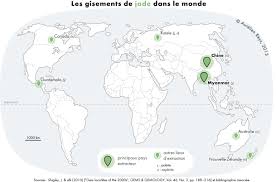
Jadeite jade is characterised by its extreme rarity. It is found in Guatemala near the Motagua Valley; in Niigata Prefecture in Japan; at Itmurundy in Kazakhstan; in Russia, mainly in the Polar Urals; and in California in the United States, in serpentine veins at New Indria. A deposit was discovered in Italy's western Alps in 2002. The most important deposit, however, is the ‘Jade Tract’, or ‘Jade Route’, in Myanmar's Kachin State.
The principal deposit is at Hpakan. Jadeite jade production in Myanmar is steadily increasing in response to the exponential demand from the Chinese market. However, Western nations' recent consideration of environmental and ethical issues associated with jade extraction has led to sanctions against the Burmese government. China did not participate in these international sanctions. The number of licences authorising mining therefore appears to be stagnating. Nephrite jade deposits are located in China, Russia, New Zealand and Canada.
Part Two: methods of identifying jade
The classification of the different types of jade was established in Hong Kong for the jade trade in the 1980s. It applies only to jadeite jade, fei cui. The ‘Standard methods for testing fei cui’ (2006) define four types of jadeite jade:
1- Type A: natural jadeite jade that has not been treated. The surface may have a wax coating to improve its lustre, but this is not regarded as a treatment.
2- Type B: jadeite jade impregnated with resin to improve transparency and chemically treated, most often by bleaching. The resulting lustre gradually disappears over time. Type B jades do not withstand heat or pressure.
3- Type C: jadeite jade that has been coloured with a dye. This treatment is not durable over time.
4- Dyed Type B+C: jadeite jade treated with chemical bleaching agents, resin-impregnated and dyed. Note also the concept of Type D jade, which appeared later and is not cited by official gemmological bodies. It is an assemblage of natural jadeite and a doublet. This category is nevertheless very uncommon.
Conventional identification tests
Conventional tests make it possible to distinguish jadeite jade from its imitations and to detect the different treatments applied to it, whether dyeing or impregnation.
Conventional tests:
10× loupe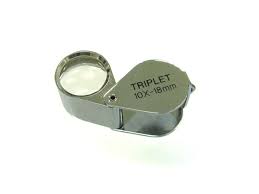
Microscope in reflected and transmitted light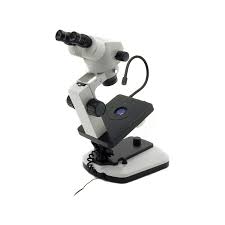
The polariscope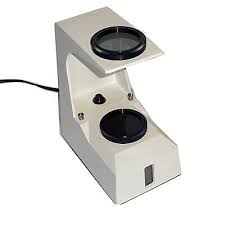
The refractometer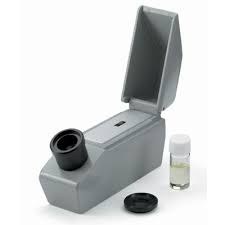
Specific gravity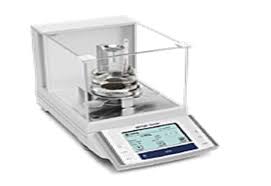
The UV cabinet
The Chelsea filter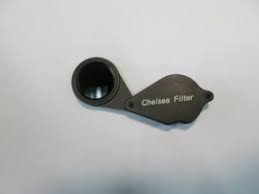
Observation with the naked eye
The stone's overall appearance, colour, lustre and transparency can be assessed. Medium- and coarse-grained structures are visible.
10X loupe
This instrument allows observation of a specimen's lustre, colour and cut and, to a lesser extent, its more or less finely grained polycrystalline structure.
Microscopic observation in reflected and transmitted light
Under the microscope, reflected light allows closer examination of the surface condition and colour and can provide a fairly precise indication of whether the jade is Type A, B or C. For example, an ‘orange-peel’, ‘fly-wing’, ‘sand-hole’ or ‘spider-web’ surface may be observed. If the stone is sufficiently translucent, transmitted light reveals the quality of the specimen's internal structure, particularly fine-grained structure.
Polariscope
The stone remains illuminated throughout a 360° rotation because it is polycrystalline.
Refractometer
The refractive index ranges from 1.64 to 1.68 for jadeite jade and is 1.62 for nephrite jade. Most specimens are cut as cabochons or beads, so a spot reading will usually be taken. For other cuts, care should be taken to select the best-polished face available. There is generally no birefringence reading because the gem is polycrystalline.
Specific gravity
Jadeite jade has a specific gravity of 3.30 to 3.36; nephrite jade ranges from 2.81 to 3.1. Specific gravity can be measured using a hydrostatic balance and the formula D = Mair / (Mair – Mwater). It can also be determined using a heavy liquid with a density comparable to that of the specimen being tested. For jadeite jade, methylene iodide may be used, with a density of 3.30 to 3.40 or above.
For nephrite jade, diluted or pure bromoform comes closest to its specific gravity, with values between 2.85 and 3.30. The specimen is immersed in the liquid until it reaches a point of suspension between floating and sinking slowly. Although less precise than hydrostatic weighing, this method allows specific gravities to be compared in the field, several specimens to be tested simultaneously, and large specimens to be assessed.
Chelsea filter
These results are not reliable on their own but can complement other observations. -Type A green jadeite: dull green, or red if it contains chromium. Chromium-bearing imperial jade also appears red. – Type C dyed green jadeite: sometimes pink or red.
UV cabinet
Long-wave UV (365 nm). Green jades; lavender; white. Light green: inert to dark red; reddish-brown for untreated stones; weak yellow; weak white. Dark-coloured jades: generally inert. Type B jadeite: often blue fluorescence under long-wave UV. Lavender colour may appear orange.
Short-wave UV (264 nm): the same observations as for long-wave UV, but weaker.
Handheld diffraction-grating spectroscope
A band is generally observed in the blue-violet at 437 nanometres (nm), indicating the presence of Fe 3+ (Fig. 2).
-Jades in various pale colours: a fine line in the blue-violet.
-‘Non-green’ translucent jades: absorption lines at 437 and 690 nm.
– Green jades: one or two lines in the red caused by chromium, and sometimes additional fine lines in the blue, which may be difficult to observe because of strong absorption.
-Imperial-type jadeite: a line at 437 nm and three fine absorption lines in the red at 630, 660 and 690 nm (Fig. 2), indicating the presence of chromium.
-Dark green jadeite: absorption lines at 630, 660 and 690 nm.
-Medium-green jadeite coloured by chromium: the same.
-Type C dyed jadeite, Fig. 1, Fig. 2: a thick absorption line between 630 and 690 nm.
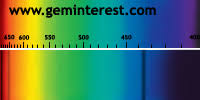
Diffraction spectroscope
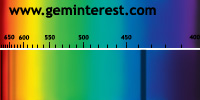
Calcite spectroscope
Laboratory tests
While Types A and C jade are relatively easy to identify using conventional identification tests, the same cannot be said of Type B jade, which requires laboratory tests.
Fourier-transform infrared spectrometer (FTIR)
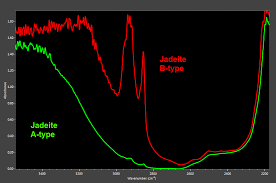
Infrared spectroscopy measures the absorption of materials in the part of the electromagnetic spectrum occupied by infrared radiation. This region is useful because of absorption by vibrations arising from the molecular and structural components of materials. It is a particularly useful instrument for detecting polymer-resin impregnation in Type B jadeite.
An FTIR spectrometer obtains spectral data from a beam containing a combination of many frequencies of light, and measures the specimen's absorption. The beam is produced by a broadband light source containing the full spectrum of wavelengths to be measured. The operation is repeated many times to obtain as many combinations as possible. Once all the data have been acquired, they are processed computationally to calculate absorption at each wavelength in reverse. This process requires an algorithm: the Fourier transform.
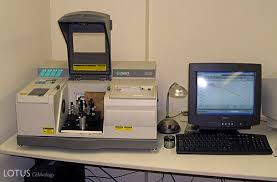
Fourier-transform infrared spectrometer (Lotus Gemology)
Interpreting the results. A group of very intense peaks — strong absorption — between 2850 cm-1 and 3100 cm-1 demonstrates polymer-resin impregnation.
(Gemmoraman.com)
The Raman spectrometer
The principle is based on a material absorbing a very high-energy beam and re-emitting a small amount of energy at another level. Among other uses, it identifies substances such as dyes, waxes and oils. Raman spectroscopy distinguishes the different types of jade — jadeite and nephrite (Fig. 1) — and treated Types B and C (Fig. 2). Nephrite jade shows a peak around 3680. Type A Fei Cui jadeite jade has no peaks above 1100 cm-1. Type B jadeite jade shows a series of peaks between 3000 cm-1 and 1610 cm-1.
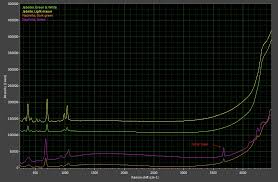
Fig. 1: Raman spectra of jadeite jade and nephrite jade (gemmoraman.com)
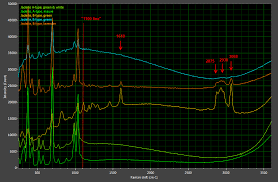
Fig. 2: Raman spectra of Type A and Type B Fei Cui jadeite (gemmoraman.com)
DiamondView
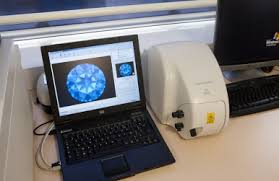
Fourier-transform infrared and Raman spectroscopy are the two preferred laboratory methods for identifying impregnation-treated jade. However, recent tests have demonstrated the reliability of the DiamondView instrument.
DiamondView (LFG)
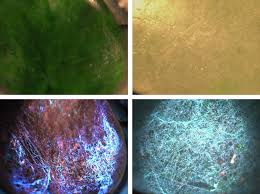
DiamondView imaging of impregnated jadeite jade specimens (Gem Lab)
Under white light, both samples display a ‘cobweb’ structure. The UV light produced by the DiamondView highlights this structure with strong blue fluorescence, clearly indicating impregnation treatment in both specimens. These findings were confirmed by FTIR and Raman spectroscopic analysis. Although further testing is needed to confirm the instrument's effectiveness, the method appears to offer a quick and simple way to identify impregnation-treated gems.
Conclusion
Jade's value continues to rise, and this trend shows no sign of weakening, especially in Asia — China and Korea. New treatment techniques intended to improve its appearance and artificially increase its value are constantly advancing. The extreme rarity of jadeite jade, particularly imperial jade, encourages the proliferation of imitations and increasingly sophisticated treatments. Laboratory instruments such as infrared or Raman spectroscopy should be used systematically for stones resembling the finest qualities of jade. The recent discovery of DiamondView's effectiveness offers solid grounds for optimism in the development of methods for identifying treated jade.
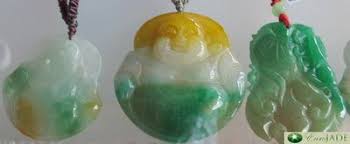
Type B+C treated jade (Eurojade)
BIBLIOGRAPHY
Jade, Roger Kerverne, Lorenz Books, 1995
Jade, des empereurs à l’Art déco, edited by Huei-Chung Tsao, MNAG, 2016
Chinese Jades, Ming Wilson, Victoria & Albert Museum, Far Eastern Series, 2004
Wan Bresson, Les Traitements de la jadéite, University Diploma in Gemmology dissertation, 2011
Testing Fei Cui Jade (Jadeite Jade), the Gemmological Association of Hong Kong (GAHK)
‘Jade’ article on the GIA website (Research and News)
‘Color origin of lavender jadeite’, Gems & Gemology, Winter 2012, Vol. 48, No. 4, pp. 273–283
Augustin Damour: ‘Notice et analyse du jade vert. Réunion de cette matière minérale à la famille des Wernérites’, Comptes rendus hebdomadaires de l’Académie des Sciences, Vol. 56, 1863, pp. 861–865
‘Application of the DiamondView in separating impregnated Jadeite’, Larry Tai-An Lai, Gems & Gemology, Fall 2016, Vol. 52, No. 3.
Websites:
Geminterest.com
Gemmo.eu
Gems-plus.com
Eurojade.com
Cover photographs : Openwork dish with a dragon motif, nephrite, Lia or Song dynasty, eleventh century, National Palace Museum, Taipei
Necklace of 27 imperial jadeite beads, dating from the late Qing dynasty (1644–1912), Cartier