
Blog
A visit to the ‘Dessins de bijoux’ exhibition at the Petit Palais


An immersive journey into the sketches that gave life to the most beautiful jewels.
It is just after ten o'clock, and I step beneath the glass roof of the Petit Palais, excited to discover a hidden treasure. For the first time, the City of Paris Museum of Fine Arts is revealing its little-known collection of jewellery drawings: nearly 5,700 sketches, gouaches and models that bring the art of jewellery to life. From the first steps into the exhibition ‘Dessins de bijoux: les secrets de la création’ — Jewellery Drawings: the Secrets of Creation, the tone is set: no display cases laden with diamonds here, but delicately drawn sheets of paper, fragile and fascinating witnesses to the creative processes of great jewellers.
It is a unique glimpse behind the scenes of jewellery, a journey from a simple scribble to a sparkling jewel. The visitor's eye is immediately drawn to a case where pencil sketches sit beside finished drawings in vivid colours: each jewel's adventure clearly begins modestly before blossoming into a work of art.
From sketch to gouache: the stages of the creative process
The exhibition's first section takes us step by step through a jewellery designer's creative process, from the initial spark to the final colour rendering. A large explanatory panel on the wall and examples under glass detail the three key stages of design:
1. The initial sketch – A first attempt, often scribbled hastily on any scrap of paper. These spontaneous sketches capture the creator's raw idea. They are rarely preserved, quickly replaced by more developed versions. Here, however, the Petit Palais presents a few fragile survivors of the waste-paper basket, offering a glimpse of creative genius feeling its way.
- The clean drawing – If the initial idea is promising, it is developed into a more precise, controlled drawing. This clean
drawing refines the shapes and incorporates the first technical constraints: how to set a particular stone, articulate a mount or ensure the jewel's strength. The ink-and-pencil drawing becomes a true technical plan for the workshops. It contains precise lines and technical notes in the margins: a roadmap guiding the jewellers as they bring the piece to life. - The final gouache – The final, vital stage: the drawing is fully coloured in gouache, with striking realism and brilliance. This gouache shows the jewel as it will appear when finished, gleaming with gold and precious stones… on paper. A work of art in its own right, it appeals to the client while guiding the craftsperson. Looking at these gouaches feels like admiring the jewels themselves, so skilfully are light and volume rendered.
In just a few display cases, visitors understand how an idea scribbled in a notebook becomes, stage by stage, a sumptuous jewel. It feels rather like leafing through a jeweller's private sketchbook, except that these pages are displayed for our delighted eyes.
Lalique and Deraisme: when nature inspires Art Nouveau
After these first technical insights, I move towards a space bathed in soft greenish light. Nature reigns supreme here, introducing visitors to the Art Nouveau aesthetic. We are surrounded by drawings filled with sinuous flowers, detailed leaves and remarkable insects. A label explains that,in the late nineteenth century, jewellery designers drew inspiration from botany and science. To devise new motifs, they assembled catalogues of natural forms: petals, vines, butterfly wings and beetle bodies.
Art Nouveau artists observed nature from every angle. They sketched outdoors in the countryside or the Jardin des Plantes, brought fresh flowers and pinned insects back to their studios, and consulted scientific books or old collections of ornament. This almost scientific observation gave rise to a rich imagination: copied nature became transformed nature. Thus, Art Nouveau jewellery reinvents reality : here an orchid becomes a fantastic chimera; there a stylised dragonfly is adorned with abstract scrolls.
Two emblematic figures guide this naturalistic chapter of the exhibition: René Lalique (1860–1945) and Pierre-Georges Deraisme (1865–1938). The display shows how Lalique, the master jeweller of the Belle Époque, and his talented younger contemporary Deraisme, who also collaborated with him as a chaser, both celebrated flora and fauna in their creations. Their drawings, exhibited side by side, reveal extraordinary precision. Finely labelled insect studies, for example, are painted in watercolour with great
delicacy. Lalique , especially renowned for nature-inspired jewellery, catches the eye with one of his most poetic gouaches: ‘Mistletoe and Cockchafer’ rings (1902–1904). On the translucent sheet, stylised mistletoe branches entwine beetles with iridescent wing cases. Heightened with touches of gouache, the drawing shimmers as if the mistletoe berries and golden beetles were coming to life before our eyes. Acquired by the Petit Palais in 2002, this marvel on paper is one of the collection's graphic jewels. Beside it, Deraisme is equally impressive: his own brooch and pendant designs, less familiar to the public, reveal nature just as enchanted.

Lalique , especially renowned for nature-inspired jewellery, catches the eye with one of his most poetic gouaches: ‘Mistletoe and Cockchafer’ rings (1902–1904). On the translucent sheet, stylised mistletoe branches entwine beetles with iridescent wing cases. Heightened with touches of gouache, the drawing shimmers as if the mistletoe berries and golden beetles were coming to life before our eyes. Acquired by the Petit Palais in 2002, this marvel on paper is one of the collection's graphic jewels. Beside it, Deraisme is equally impressive: his own brooch and pendant designs, less familiar to the public, reveal nature just as enchanted.
Contemplating these drawings makes clear how completely nature inspired Art Nouveau jewellers. But the exhibition does not stop there: the route leads us towards other stylistic horizons, where new houses and creators take over.
Cartier and Charles Jacqueau: the legacy of gouache in the twentieth century
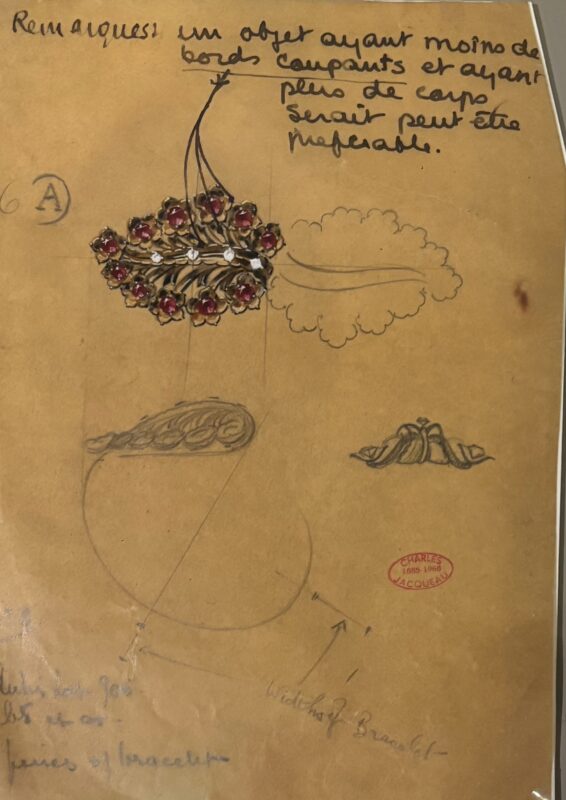
A little further on, a large period photograph of Cartier's workshop draws the eye, signalling our entry into the world of the House of Cartier, founded in 1847. The scene changes: Art Nouveau's plant-like scrolls give way to the restrained elegance of Art Deco and the extravagance of the Roaring Twenties. The cases now contain drawings from the 1920s to the 1940s, with geometric motifs and bold colours dominated by the brilliance of diamonds. Charles Jacqueau (1885–1968), Cartier's head designer for decades, is the star of this section.
His refined gouaches are miniature paintings, subtly using colour to indicate materials: a line of white gouache means platinum and diamond settings, while a flat area of yellow or red suggests gold, rubies or emeralds. This colour coding in jewellery drawings is a delightful discovery for a layperson like me. Looking at an enchanting bracelet design, I enjoy guessing which gem corresponds to each shade applied by Jacqueau, as though deciphering a secret code.
Among the works on display, several iconic Cartier creations enter into dialogue with their preparatory drawings. It is impossible not to pause before the 1944 ‘Bird’ brooch, on loan from the Cartier Collection: a delicate gold and platinum pin set with diamonds, sapphires, rubies and emeralds, depicting a little bird.
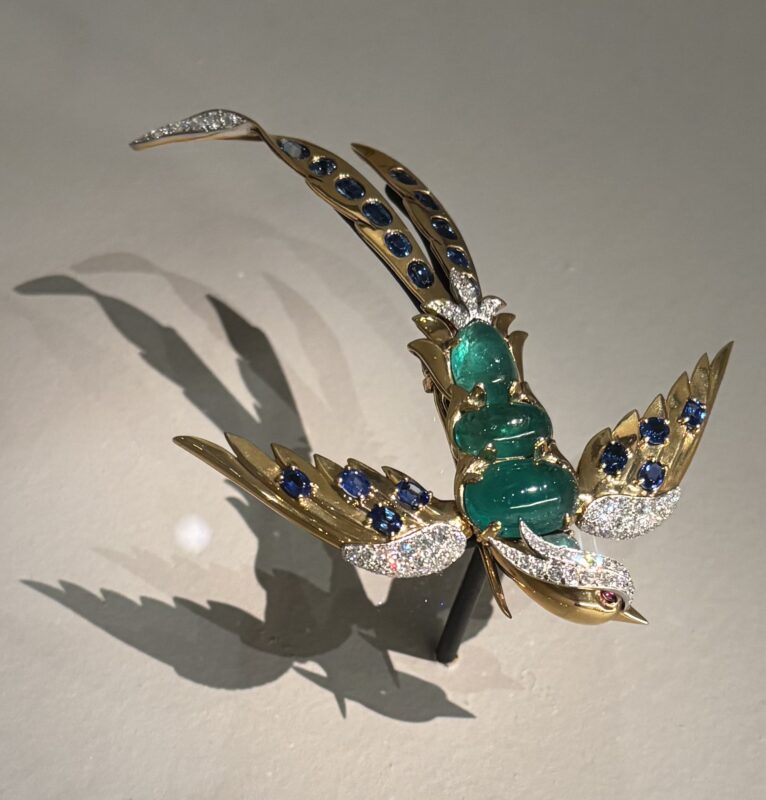
Beyond its beauty, the piece takes on a particular resonance when its history is known: designed during the Second World War, Cartier's bird brooch symbolised the hope of freedom — a caged bird during the Occupation, then a freed bird at the Liberation. Seeing this historic jewel alongside its preparatory drawings adds a moving dimension to the visit, as though the context and emotions of its creation can be sensed behind the stones' brilliance.
A little further on, a quotation painted on the wall catches my attention: ‘If I needed to spend a few hours in libraries and museums to find inspiration of any kind, I was entirely free to do so.’ These are Alphonse Fouquet's words from 1899, recalling how strongly the search for artistic inspiration was encouraged among jewellers. This historical touch echoes what we saw with Lalique and Deraisme: behind every floral motif or Cartier bird lay hours of observation, research and artistic reverie.
The Cartier/Jacqueau section also offers fascinating stories behind the designs. Before a series of 1930s brooch drawings, our guide — let us imagine an exhibition mediator accompanies us — tells the delightful story of an indecisive client. Five clip designs, small clasp brooches, are arranged on one sheet, each using the same precious stones differently. These are five variations on a single jewel, presented to a wealthy client to make her choice. One can imagine her hesitation before so many wonders on paper…
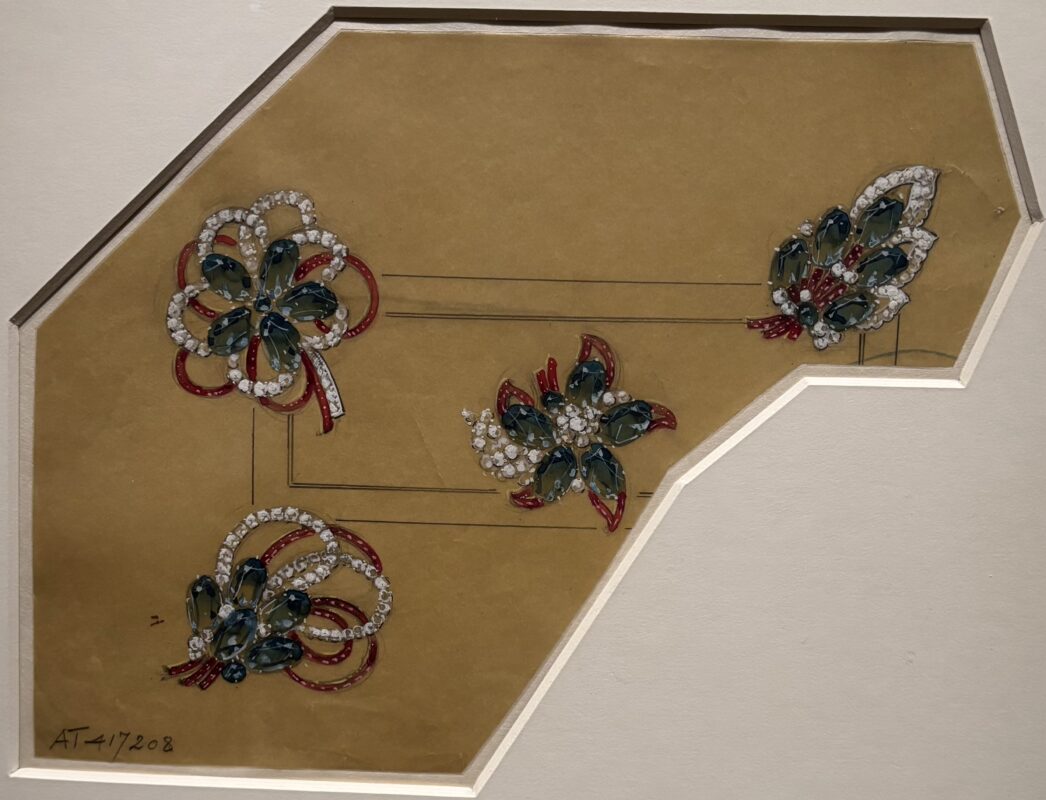
Jacqueau, they survived the century and now belong to the Petit Palais collection, donated by the Jacqueau family in 1998. The exhibition brings them together for the first time more than sixty years later, symbolically surrounding the absent fifth original drawing, which remains in Cartier's archives alongside the finished jewel. Looking at these four orphaned drawings, their gems painted in gouache, brings us close to the private processes of jewellery houses: we imagine the scene, the quiet dialogue between client and designer, and the decisive moment when one sketch is chosen to move from dream to reality.
Another remarkable work in this section consists of two large drawings depicting a sumptuous maharajah's headdress. At first glance, these richly detailed gouache designs, filled with diamonds, pearls and arabesques, promise a jewellery masterpiece. They are in fact two proposals made by Charles Jacqueau in the 1920s for a special commission from an Indian prince, who wanted the stones from his old jewellery reset into a spectacular new head ornament.
An ambitious project that never came to fruition : we learn that, for unknown reasons, the commission was never completed, and these drawings are all that remain. They are all the more precious for bearing witness to the appeal of maharajahs as clients for great Parisian jewellers in the early twentieth century, and to the unrestrained creativity inspired by these dreams of the East.
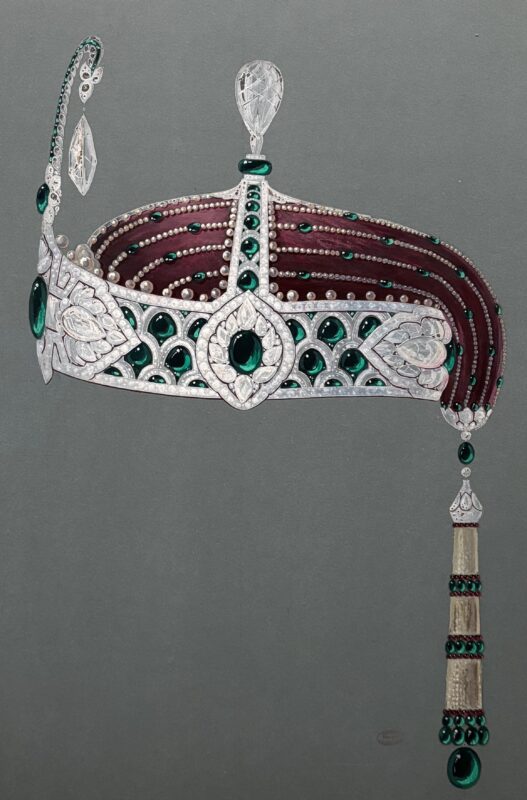
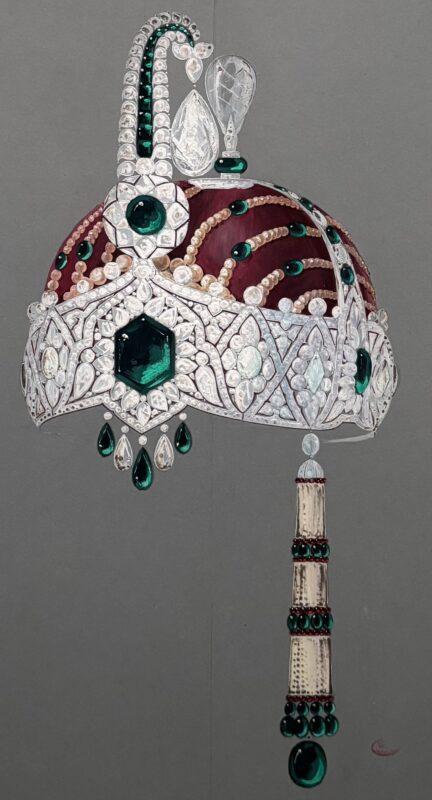
On closer inspection, we notice that some diamonds in these designs have turned a dull grey. Strange for stones meant to sparkle so brilliantly! An explanatory note provides the answer: the white gouache used to depict diamonds' pure brilliance has deteriorated with age, turning blackish grey through oxidation. This little scientific fact, which surprises me, shows that jewellery drawings also suffer the ravages of time.
As the paint darkens, the original colour code becomes confused and the drawing harder to read — ironic given how important those colours were in accurately indicating materials. These may be the concerns of a museum curator, but the exhibition makes them fascinating through concrete examples. In an instant, we realise that these fragile sheets, although sheltered in boxes for decades, live and age almost as much as the jewels they helped to create.
The circumstances of creation: clients, workshops and competitions
By this stage of the visit, we realise with wonder that every jewellery drawing has its own history linked to its purpose. An explanatory panel entitled ‘The circumstances of creation’ clarifies precisely this point. A jewellery drawing was more than a beautiful exercise in style: it had a specific role in the creative chain, and its form varied according to its intended recipient. The exhibition invites us to consider three typical uses:
- The workshop's technical drawing : here the drawing is intended above all for craftspeople, requiring clarity and accuracy. It might be a dimensioned scale drawing, sometimes without unnecessary colour, sent to the jewellery house's workshops to guide the making of the piece.
- The client presentation drawing : here the designer brings out the finest brushes! When the aim is to appeal to a wealthy client or persuade her to commission a piece, the drawing becomes a true piece of visual communication. Sumptuous gouache, a jewel displayed against a coloured background or shown in context — imagine a tiara drawn on the outline of a head — everything is intended to capture the client's imagination and make the jewel desirable. This highly polished type of drawing serves, in a sense, as a sales tool .
• The competition or exhibition drawing : sometimes a jeweller creates a piece specifically for a world's fair or an artistic competition. The preparatory drawing must then persuade a jury. It again needs to be especially accomplished, but perhaps with greater emphasis on innovation and originality. The designer adapts the style to highlight what will impress the experts assessing the project.
According to the recipient — workshop, client or jury — jewellery designers therefore adapted their drawing style. The same artist might make a highly restrained workshop sketch one day and a flamboyant client-presentation gouache the next. Several old sheets in the cases reveal these exchanges between design and manufacture: some carry mysterious marginal notes, numerical codes or revision instructions. These often record technical comments exchanged with craftspeople while a project was being developed.
On one sheet, for example, a small correction in red ink was probably added later to adjust a stone's size or a motif's thickness following a master craftsperson's recommendations. These working documents quietly tell the story of close collaboration between the designer and the jewellery workshops, showing that creating a jewel is as much a collective effort as an artistic one.
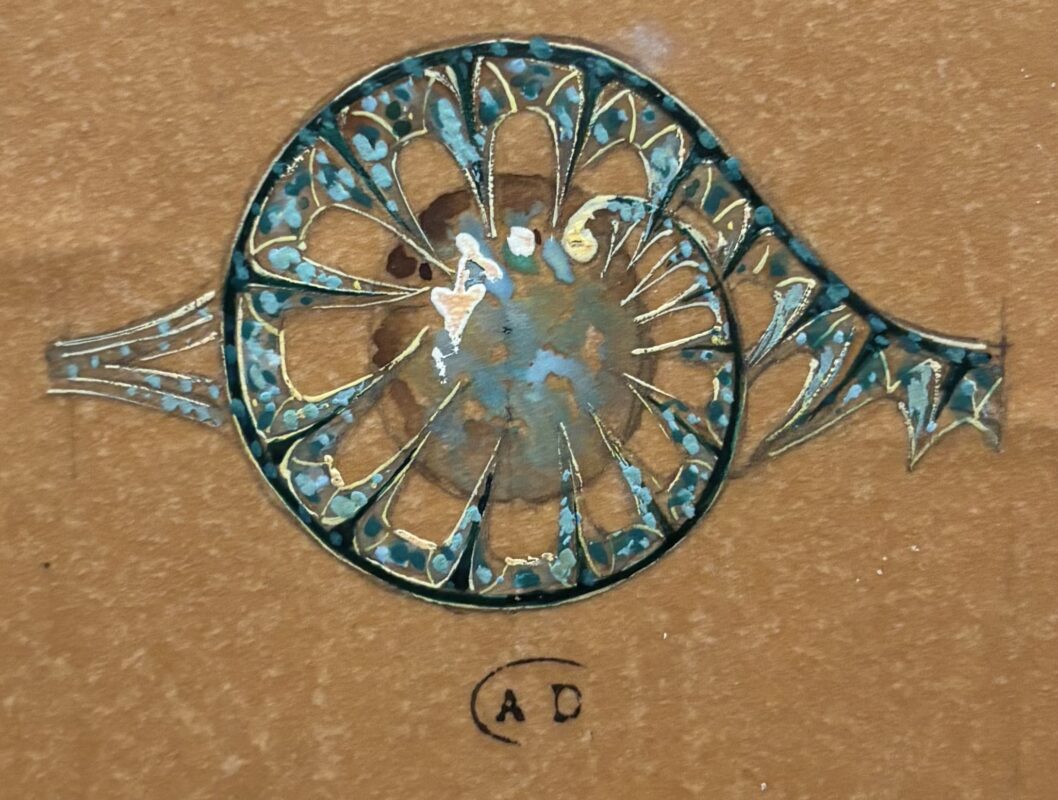
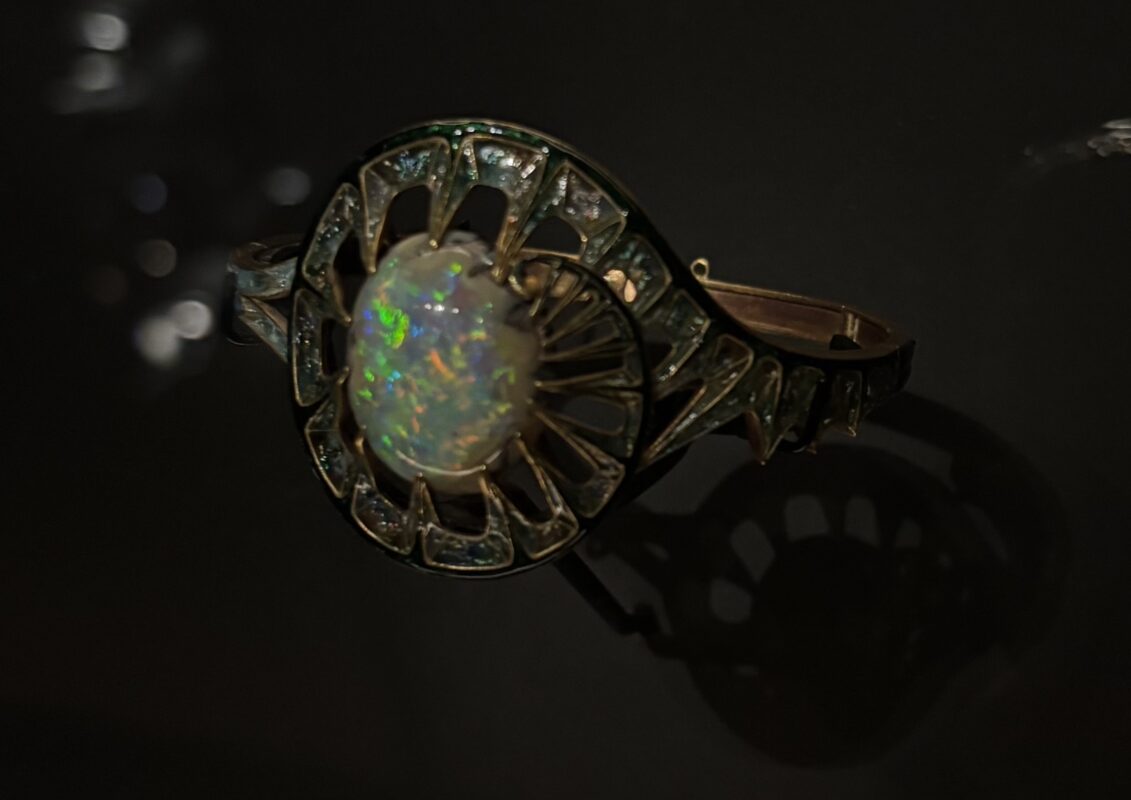
The exhibition also illustrates these creative circumstances through finished pieces. In the same room, my attention is drawn to a magnificent ‘Thistle Leaf’ bracelet in gold and cloisonné enamel, enhanced with a sparkling opal. Made between 1905 and 1909 by the House of Fouquet, it is displayed alongside its preparatory drawing. Interestingly, the label states that it was based on a design by Charles Desrosiers, a designer of the period.
We understand that Georges Fouquet, the great Art Nouveau jeweller, called on Desrosiers' talent to devise this stylised thistle motif, which was then made in Fouquet's workshops. Seeing the drawing and finished jewel together allows us to appreciate the faithfulness — or differences — between the paper design and its three-dimensional realisation. It is an exquisite marriage of art and technique, and we find ourselves examining every detail to discover what was adjusted along the way.
A second life: what becomes of jewellery drawings?
Today, jewellery drawing is enjoying a true revival. As a text in one of the display cases explains, these drawings, once ephemeral working tools, are now far better preserved, both within jewellery houses themselves and in public and private collections. Several factors explain this renewed appreciation.
First, drawings extend the life of a jewel : once a piece has been made, its drawing can be used again, for example to recreate an exact copy later or inspire a new variation. At the great jewellery houses, old gouache drawings become reference material, rather like a visual catalogue of possible designs to show future clients seeking inspiration. They are an integral part of a house’s communication, conveying its style through time.
As I leave the exhibition, I am struck by the magic of the experience. Over the course of a few rooms, I have had the privilege of travelling back in time and stepping into the workshops of great jewellers, without leaving the museum. Each drawing has told me a story — the birth of a tiara, the inspiration of a master glassmaker fascinated by an insect, an extravagant commission from an Eastern prince, or the boldness of a jewellery house
As I leave the exhibition, I am struck by the magic of the experience. Over the course of a few rooms, I have had the privilege of travelling back in time and stepping into the workshops of great jewellers, without leaving the museum. Each drawing has told me a story — the birth of a tiara, the inspiration of a master glassmaker fascinated by an insect, an extravagant commission from an Eastern prince, or the boldness of a Parisian house defying history with a patriotic brooch.
The Petit Palais exhibition ‘Jewellery Drawings’ succeeds in bringing these stories of paper and ink to life, entertaining as much as it informs. You leave with stars in your eyes and an irresistible urge to dig out old family sketchbooks — who knows, a treasure may be hidden inside!
A word to enthusiasts and curious visitors alike : this unique exhibition is a springtime must-see. It runs at the Petit Palais until 20 July 2025 — do visit and discover this sparkling world behind the scenes for yourself. You will never look at your jewellery in quite the same way, and perhaps your next sketches will inspire a new sense of wonder. Enjoy your journey into the world of jewellery drawings!
At Ckystones, we offer a bespoke design service in collaboration with jewellery gouache artists and jewellers.