Blog
Opal: where light meets geology

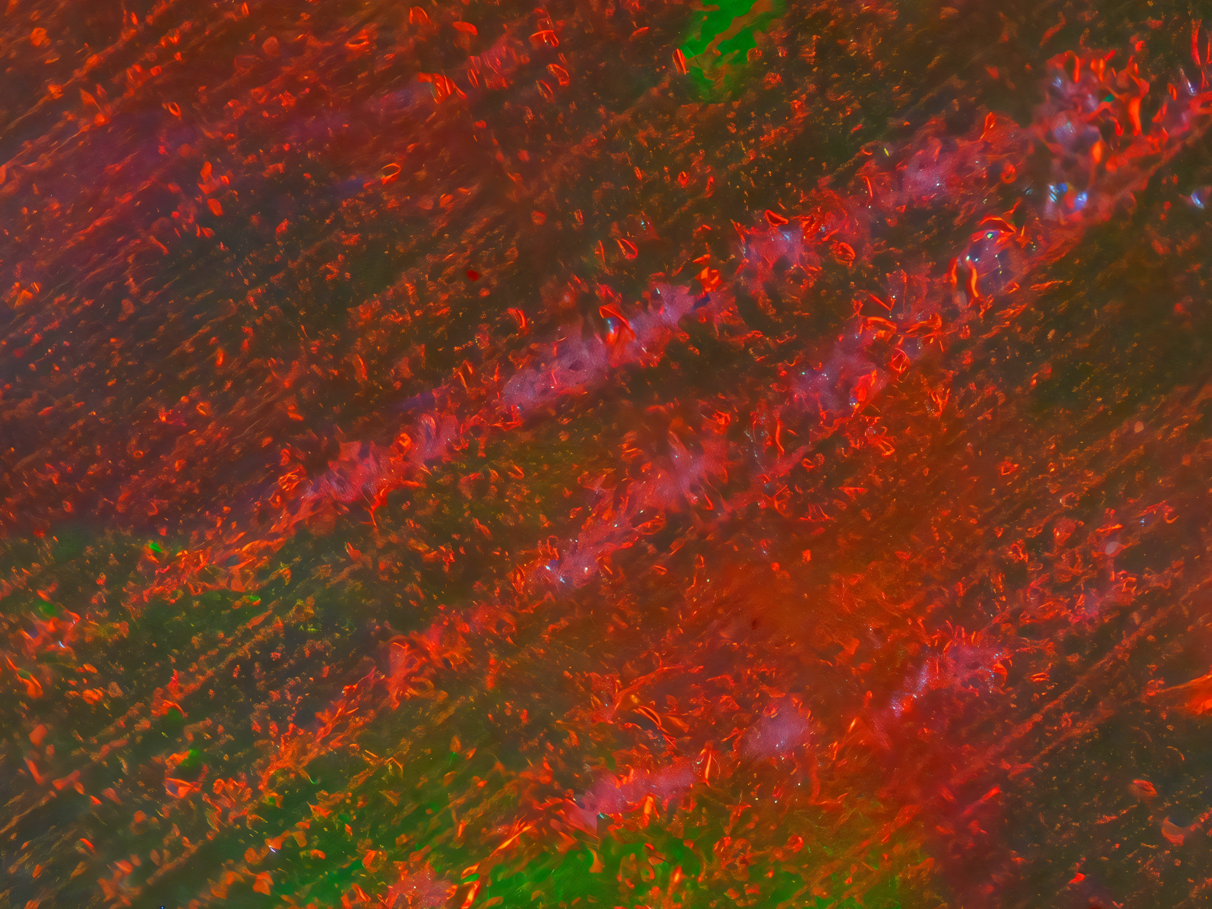
With its shifting play of colour and iridescent reflections, opal occupies a unique place in the gemstone world. As an amorphous material, it falls outside traditional mineralogical classifications. From Australia to Ethiopia, each deposit has its own signature, reflecting a complex geological history and a very particular environment of formation.
Composition and structure
Opal is an amorphous hydrated silica, with the general chemical formula SiO₂·nH₂O, usually containing between 3% and 10% water (sometimes up to 20% in certain unstable varieties).
Its structure consists of silica microspheres (0.15 to 0.4 µm in diameter) arranged with varying degrees of regularity. The interference of light on these spheres produces its famous play of colour.
Two main types of opal are distinguished:
- Precious opals (with play of colour);
- Common opals (opaque or translucent, without iridescence).
The average specific gravity ranges from 1.98 to 2.25, and hardness varies from 5.5 to 6.5 on the Mohs scale (depending on the variety). This relative fragility explains why many opals are set in protective settings or made into doublets or triplets for jewellery.

Opal through history
Known since antiquity, opal was regarded by the Romans as the stone of luck and fidelity. Pliny the Elder described it as ‘the fusion of the fire of ruby, the brilliance of amethyst and the green of emerald’.
In the Middle Ages, it was sometimes feared: it was believed to absorb vital energy, particularly because it lost its lustre when it dried out.
Opal truly came into its own in the 19th century, with the discovery of major deposits in Australia. The country then became the world's leading supplier, still accounting for the finest specimens today.
The major opal deposits
– Australia, the world's opal heartland
Australia is by far the most famous and varied source of opals, with each region producing distinctive specimens:
- Lightning Ridge (New South Wales)
Renowned for its black opals, the most sought-after on the market. Their dark background, caused by the presence of carbon or iron oxides, intensifies the play of colour. Fine specimens display electric flashes of blue, green and red, sometimes known as a ‘Harlequin Pattern’. - Coober Pedy (South Australia)
Known as the ‘opal capital of the world’, this region mainly produces white and crystal opals. The town itself was built partly underground to escape the desert heat. - Andamooka (South Australia)
A historic source of light-coloured opals, sometimes treated to darken their base and imitate black opal. Some pieces have adorned Queen Elizabeth II's crown. - Boulder Opal – Queensland
In the Winton, Quilpie and Yowah regions, opals form directly within an ironstone or sandstone matrix. These ‘boulder opals’ display coloured veins embedded in the host rock, often with spectacular iridescence. - Mintabie (South Australia)
A formerly productive deposit, now closed, known for its grey-black opals with blue-green flashes.
Each Australian sedimentary basin dates from the Cretaceous, with opals forming in ancient layers of siliceous sandstone through the percolation of silica-rich water.
Other notable origins
Ethiopia (Wollo province / Wegel Tena)
Discovered in 2008, Welo opal is now the main competitor to Australian opal. It ranges from translucent to milky, with clear play of colour. However, some pieces are hydrophane, meaning they absorb water and may temporarily change appearance.
Indonesia
Opaque blue-green opals with an intense colour that can be confused with chrysocolla.
Mexico (Querétaro, Jalisco)
A source of fire opals in vivid red to orange shades, sometimes translucent and sometimes without play of colour. Some are set rough or cut as cabochons.
Brazil (Pedro II, Piauí)
Known for its white and crystal opals, often exported to Japan. Production remains modest, but its transparent material is excellent.
Honduras (Lempira, Erandique)
Deposits of black matrix opal, containing tiny spheres of opal scattered through a dark volcanic rock, creating a very distinctive starry effect.
United States (Virgin Valley, Nevada)
Small opal deposits, sometimes unstable (crazing as they dehydrate), but highly sought-after by collectors.
Slovakia (Dubník)
An ancient source of opals mined since Roman times, notably used in the Habsburg jewels.

Opal treatments
Opal dyeing and darkening methods vary and are mainly applied to porous (hydrophane) opals or matrix opals to strengthen the contrast of their play of colour and imitate black opal. They include soaking in dyes, impregnation followed by sugar carbonisation, smoke treatment and sometimes the use of inks to darken specific areas of the matrix. These processes have existed for a long time and are now mainly encountered in Ethiopian hydrophane opals and certain Andamooka/Coober Pedy opals intended to appear ‘blacker’.
- Doublets and triplets
To protect and enhance fine opals. A doublet combines a thin layer of opal with a black backing (obsidian, glass or basalt).
A triplet adds a dome of transparent quartz on top.
These constructions are common, particularly with Australian opals.
- Stabilisation by impregnation
Fragile or porous opals may be impregnated with resin or oil to prevent dehydration. This treatment is rare in precious opals but common in certain Honduran matrix opals.
Opal in contemporary jewellery
Opals remain very prominent in high jewellery, particularly thanks to Australian and Japanese artisans. Each type of opal inspires distinct styles:
Lightning Ridge for classic, luxurious pieces,
Welo for modern, translucent creations,
Boulder opal for organic designs in which the matrix becomes an integral part of the aesthetic.
Their beauty remains unsurpassed, but their fragility calls for care: avoid thermal shock, solvents and prolonged exposure to sunlight.
Some houses (such as Tiffany & Co or Cartier) have reintroduced black opal since the 2010s, particularly in combination with diamonds or spinels.
Opal is one of the few gemstones that can be considered ‘living’, sensitive to its environment. It tells the story of ancient waters trapped in rock millions of years ago, and continues to interact with the surrounding humidity today.
From Australia's Lightning Ridge to the Ethiopian highlands, this incredible stone offers a whole spectrum of colours, combining science and fascination.

Bibliography
- GIA – Opal: History, Sources and Treatments (2023)
- SSEF – Opal Treatment and Identification, Facette no. 18, 2017
- Gem Research Swisslab – Hydrophane Opals from Wollo, Ethiopia (2020)
- Mindat.org – Opal Localities in Australia (2024)
- GIA – The Opal Fields of Lightning Ridge (2022)
- Australian Museum – Coober Pedy & Boulder Opal Geology (2023)
- Smithsonian NMNH – Opal: A Gem of Geological Time (2024)