
Blog
Aquamarine: a gem between sky and sea


Among the gemstones most admired for their brilliance and freshness, aquamarine holds a special place. Less widely discussed than diamond, emerald or ruby, it has nevertheless captivated people since antiquity with its light blue colour, reminiscent of clear, transparent waters. A gemstone of the beryl family, aquamarine is now sought after by both jewellers and collectors.
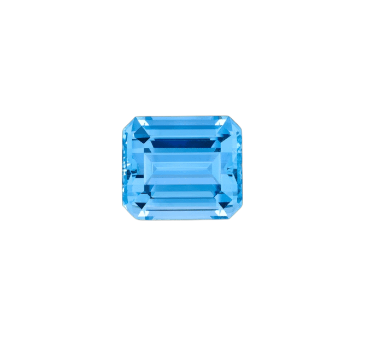
The name ‘aquamarine’ comes from the Latin aqua marina, literally meaning ‘seawater’. It perfectly reflects the stone’s colour, ranging from sky blue to blue-green and evoking the changing shades of the oceans.
Mineralogically, aquamarine belongs to the beryl group. Its blue colour comes from traces of iron in its crystal structure. It is therefore a blue variety of beryl, just as morganite is pink and heliodor yellow.
Characteristics and colour palette
Aquamarine crystallises in the hexagonal system and often forms large hexagonal prisms with well-defined edges. Its hardness of 7.5 to 8 on the Mohs scale makes it a durable stone, well suited to jewellery.
Its colour palette extends from very pale, almost colourless blue to intense blue with a greenish tinge. The most prized stones show a deep blue, sometimes described as ‘Santa Maria blue’, referring to the Brazilian deposits famous for this shade.
Some stones can show slight pleochroism — a change in colour with viewing angle — ranging between blue and blue-green
Aquamarine is one of the gemstones most commonly heat treated. This stable, irreversible process removes greenish tones to bring out a purer, more appealing blue. Most aquamarines on the market have therefore undergone gentle heating, generally at temperatures between 400 and 500 °C.
Unlike other gems, aquamarine is not subject to impregnation or dye treatments. Heating remains the standard practice accepted in gemmology.
As for synthesis, blue beryl can be produced in laboratories, notably by hydrothermal growth, but these synthetic stones remain rare and are not commonly encountered in the consumer market. They are mainly used for research or industrial applications.
In jewellery, the market is based on natural stones, which may have been heated.
Aquamarine through history
The history of aquamarine is closely linked to the discovery of its major deposits, which shaped its use in jewellery. It was already mined in the Middle East and Egypt in antiquity, where evidence of blue beryl use can be found.
From the 18th century onwards, the discovery of important deposits in Russia’s Urals helped popularise aquamarine in Europe. However, Brazil transformed the market with the opening of mines in Minas Gerais in the 19th century: crystals of exceptional clarity, sometimes weighing several kilograms, began supplying the great European jewellers.
In the 20th century, the exploration of new producing regions such as Pakistan, Nigeria and Madagascar confirmed aquamarine’s status as a global gemstone. These successive discoveries broadened the range of available colours, with certain regions known for particularly intense shades.
More than its symbolic role, the great milestones of mineral exploration shaped aquamarine’s place first in royal collections and then in modern jewellery.
Today, aquamarine is mined in many countries, but Brazil remains the benchmark, with the famous exceptionally deep blue crystals from the ‘Santa Maria’ mine.
Other notable deposits include:
⦁ Pakistan (Shigar Valley, Gilgit-Baltistan): renowned for crystals of spectacular size and clarity.
⦁ Madagascar: an important source of richly coloured blue stones.
⦁ Nigeria and Mozambique: more recent producers supplying the international market.
⦁ Russia (Urals) and the United States (Colorado): historic localities famous for collectors’ specimens.
Long regarded as secondary to the ‘big four’ — diamond, ruby, sapphire and emerald — aquamarine is now attracting renewed interest. Its soothing blue and ready availability in large sizes appeal to contemporary jewellers, who incorporate it into their creations.
Aquamarines with strong colour, particularly ‘Santa Maria’ varieties, now command high prices in the gemstone market, sometimes rivalling some of the four major precious stones. Very pale stones, which are common, are more affordable.
In recent years, new African deposits, particularly in Nigeria and Mozambique, have expanded supply, confirming aquamarine’s place as an essential gemstone.
Both understated and brilliant, aquamarine embodies harmony between sky and sea. A protective stone for sailors, a gem prized by sovereigns and a contemporary jewel, it continues to enchant gemstone enthusiasts with its timeless beauty.
An elegant alternative to more famous gems, it appeals to jewellers and collectors alike. Today, aquamarine is establishing itself not only as a charming stone but also as a dependable choice in the world of jewellery and gemmology.

Public domain

Bibliography
⦁ Earth Materials: Components of a Diverse Planet, Dexter Perkins; Kevin R. Henke; Adam C. Simon; Lance D. Yarbrough; CRC Press, 2019-07-24.
⦁ Gems and Gemstones: Timeless Natural Beauty of the Mineral World, Lance Grande; Allison Augustyn; University of Chicago Press, 2009-11-15.
⦁ Emerald & Other Beryls, John Sinkankas; Geoscience Press, 1994.
⦁ Heat Treatment of Aquamarine and Morganite From Madagascar, Chawalit Chankhantha; Panjawan Thanasuthipitak; 38th Congress on Science and Technology of Thailand, 2012.
⦁ Aquamarine, Maxixe-type Beryl, and Hydrothermal Synthetic Blue Beryl: Analysis and Identification, Ilaria Adamo; Alessandro Pavese; Loredana Prosperi; Valeria Diella; David Ajò; G. Diego Gatta; Christopher P. Smith; Gems & Gemology, Vol. 44, No. 3, 2008.
⦁ The Effect of Heat Treatment on Colour, Quality and Inclusions of Aquamarine from China, The Journal of Gemmology, 01/01/2007
⦁ Aquamarine with Unusually Strong Dichroism, Gagan Choudhary; Gems and Gemology, Fall 2014.
⦁ Mysterious Iridescence in Aquamarine, Nicole Ahline; Maryam Mastery Salimi; Gems and Gemmology, 07/08/2017.
⦁ Mineralogical, Geochronological and Geochemical Characterization of Early Devonian Aquamarine-Bearing Dykes… Zealand Station (Canada), K.L. Beal; David R. Lentz; Douglas C. Hall; Gregory Dunning; Canadian Journal of Earth Sciences, 2010.
⦁ Aquamarine in the United States, Mark I. Jacobson; Rocks & Minerals, 1993.
⦁ Inclusions in Aquamarine from the Suprunovskoye Pegmatite Deposit, Russia, E. I. Gerasimova; M. F. Vigasina; V. Yu. Prokofiev; E. V. Nagornaya; Acta Geologica Sinica (English Edition), 2014.