Blog
Tourmalines: a mineral kaleidoscope


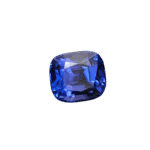
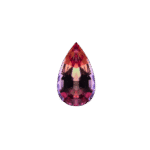
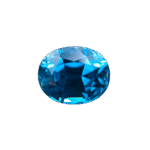
Few gemstones rival tourmaline for diversity of colour. Its name, from the Sinhalese toramali or turamali meaning ‘stone of mixed colours’, aptly captures its essence. Whether rubellite red, verdelite green, indicolite blue, vivid yellow, soft pink or even bicoloured like the famous ‘watermelon’ varieties with their contrasting green and pink, tourmaline embodies a mineral rainbow. Long little known in Europe, it gained recognition over the centuries through the fascination it inspired, both for its beauty and for its unusual electrical properties, studied as early as the 18th century. Today, it has become an essential gemstone for jewellers, collectors and scientists alike.
Tourmaline is not a single mineral but an entire group of complex borosilicates. Its highly variable chemical formula explains its wealth of colours and many varieties. It crystallises in the trigonal system, in elongated prisms with characteristic vertical striations. Its hardness, between 7 and 7.5 on the Mohs scale, gives it good resistance suitable for jewellery. Its refractive indices range from 1.61 to 1.66 and its specific gravity from 3.0 to 3.2.
Scientists also observed that tourmaline has electrical polarity: when heated or subjected to pressure, it develops opposite charges at its ends. These pyroelectric and piezoelectric properties, rare in the mineral world, contributed to the interest it attracted in the early study of electricity.
Tourmaline's richness is reflected in a series of varieties that have become iconic. Elbaite, rich in sodium, aluminium and lithium, is one of the most sought-after for its transparency and vivid colours. Black, common schorl was long overlooked, but remains important for decorative purposes. Dravite, tending towards brown to yellow, is characteristic of magnesium-rich deposits.
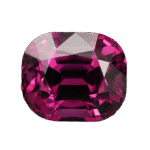
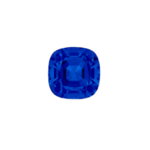
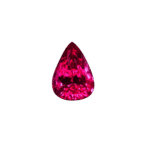
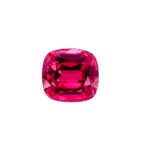
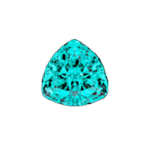
Certain colours have become established benchmarks : rubellite for its intense reds and pinks, indicolite for its deep blues, and verdelite for its luminous greens. The most famous variety, however, is undoubtedly Paraíba, discovered in Brazil in 1989, whose neon-blue to electric-green shades, caused by copper and manganese, transformed the coloured gemstone market and reached values comparable to exceptional sapphires and emeralds.
Deposits and provenance
Tourmaline is a truly cosmopolitan gemstone. It occurs mainly in granitic pegmatites, but also in certain alluvial deposits. Brazil has remained a major producer since the 19th century, with famous sites in Minas Gerais. It was also in Brazil, in the state of Paraíba, that the first copper-bearing tourmalines were discovered in the late 1980s; today, they are sought-after worldwide.
Since then, new sources have emerged in Africa, particularly Mozambique and Nigeria, producing Paraíba tourmalines that rival Brazilian examples in beauty. Afghanistan and Pakistan are known for their exceptional green, blue and pink elbaites from high-altitude pegmatites in the Hindu Kush and Karakoram. Madagascar, with its varied deposits, supplies a full range from rubellites to spectacular bicoloured stones. The United States has also played a part in tourmaline's history: the mines of Maine and California, very active in the 19th century, supplied Western jewellery workshops and remain prized by collectors. Finally, Sri Lanka, already renowned for its corundum, supplied alluvial tourmalines as early as the 17th century, helping introduce them to Europe through Dutch merchants.

History and jewellery
In Asia, tourmaline had been known since antiquity, but was often confused with other coloured gems. It only reached Europe in the 17th century, imported from Sri Lanka, where Dutch merchants gave it the name that would become widespread. By the following century, European scholars were studying its electrical properties, observing that a heated stone could attract dust and ashes. This behaviour, which earned it the nickname ‘ash stone’, featured in the earliest experiments with static electricity.
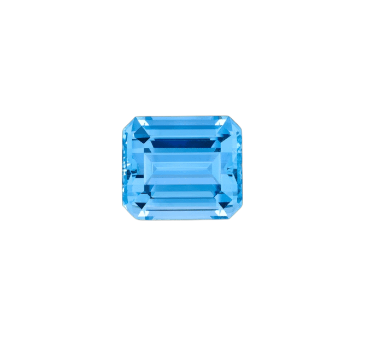
Thanks to its hardness and lustre, tourmaline is a particularly versatile gemstone. It lends itself to brilliant and emerald cuts as well as cabochons, depending on its transparency and colour. Paraíba tourmalines, with their electric colours, are among the most expensive stones on today's market. Bicoloured varieties appeal for their originality, particularly watermelon tourmalines, often presented as polished slices to showcase the natural transition between colours. Rubellites, verdelites and indicolites, meanwhile, find their place in all kinds of high jewellery creations.
Treatments and imitations
Like many coloured stones, tourmaline can be enhanced by heat or irradiation to intensify or alter its colour. These treatments are stable and generally accepted on the market, provided they are disclosed. Imitations remain rare: some coloured glass and experimental synthetics circulate, but do not pose a serious threat.
Tourmaline's value extends beyond gemmology. Thanks to its variable composition, it is an excellent geochemical indicator of the conditions in which rocks form, allowing geologists to reconstruct pegmatite or metamorphic rock environments. Its electrical properties are also of interest to applied science: it is used in certain sensors, measuring instruments and technological devices, confirming its importance far beyond jewellery.
Tourmaline embodies both the diversity and complexity of the mineral world. It stands out for its rich colours, the rarity of certain varieties such as Paraíba, the diversity of its deposits and its unique properties. A gemstone for jewellers, a stone for collectors and an object of scientific study, it fully deserves its nickname, the ‘mineral kaleidoscope’. Wearing a tourmaline celebrates nature's creativity and our planet's extraordinary geological richness.
Bibliography:
- GIA — Tourmaline: varieties, treatments, and identification (gemmological reports, 2023).
- Mindat.org — Tourmaline group mineral data (accessed in 2025).
- Giuliani, G. et al. — Les gemmes — BRGM Éditions, 2009.
- Laurs, B.M. — Paraíba Tourmaline from Brazil — Gems & Gemology, 1990.
- Laurs, B.M., Falster, A.U. — Gem Pegmatites of Afghanistan and Pakistan — Mineralogical Record, 2005.
- Deer, W.A., Howie, R.A., Zussman, J. — Rock-Forming Minerals, Volume 1A: Orthosilicates — Geological Society, 1997.
- Giuliani, G., Fallick, A.E., Ohnenstetter, D. et al. — Tourmaline: A petrogenetic indicator mineral — Mineralogical Magazine, 2000.
- London, D. — Pegmatites — Mineralogical Society of America, Reviews in Mineralogy & Geochemistry, Vol. 69, 2008.
- Walter, M.A. — Tourmaline: A Gemmological Guide — Lithographie Press, 2011.